
Order batching and pick routes in an e-commerce warehouse
Which orders go on which trolley, and in which order does the picker walk the aisles?
Result in this example, compared with “order by order”: walking 1,924 m instead of 3,538 m, lines per picker hour 109 instead of 68, wave done after 15 min instead of 23 min.
E-commerceSpare partsPharma wholesale
Drag to rotate, scroll or pinch to zoom. The schedule below plays the plan; hover a bar for details.
The planning question
An e-commerce shelving hall with 12 narrow aisles, a middle cross aisle and 900 articles in chaotic storage. A morning wave is picked with trolleys that carry several order buckets; pick & pack is along the west wall. Today, whole orders go in order of arrival to the next trolley with free buckets, and the picker walks the lines in location sequence.
How we plan it
Batching and routing are solved together: orders whose articles are close together share a trolley.
What the plan shows
| KPI | Optimized plan | Comparison: order by order |
|---|---|---|
| walking (m) | 1,924 −1,614 | 3,538 |
| wave done after (min) | 15 −8 | 23 |
| lines per picker hour | 109 +41 | 68 |
Decisions
- trolley and bucket per order (batching)
- pick sequence per trolley (route through the aisles)
Constraints
- bucket and trolley capacity
- orders are not split over trolleys
- aisle layout with cross aisle
- wave end time
Objective
short walking distance, wave finished early, more lines per picker hour
Questions
Does it need a new warehouse system?
No. Orders and locations come from the existing WMS; the optimized batches and pick lists go back to it.
What about multi-level racks?
Levels and lift times can be part of the walking-time model.
More use cases
Parcel hub dock scheduling
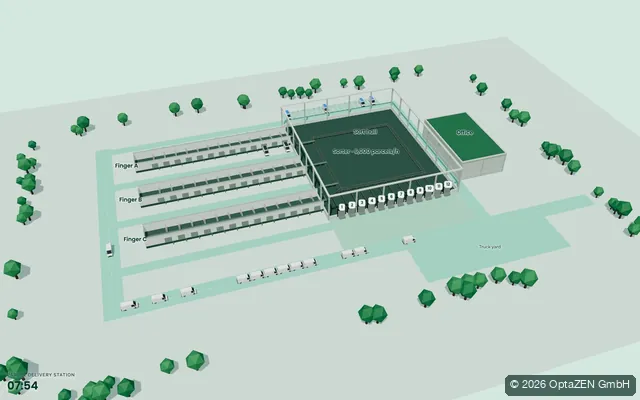
Overnight trucks, 12 doors, a sorter for 6,000 parcels per hour and 78 van bays. The morning delivery wave has to leave on time.

Warehouse slotting
400 articles, 624 pick slots on three levels: fast movers near goods out, heavy goods low, the ergonomic level for high volume.

Intermodal terminal crane scheduling
Two gantry cranes on one runway, three trains and the trucks of the day. Every train has to leave full and on time, and the trucks should not queue.
The first step
Where does your planning lose time, capacity or money?
In a free first call we work out which next step is really worth it.