
Home / Industries / Healthcare
Home care routes, care home rosters06:30, and every route fits.
In home care the route has to be ready before the first car leaves. In a care home every shift needs enough registered nurses. We compute visit windows, skill ratio, continuity of care and working time law in one plan.
Two planning tasks
Routes for home care, rosters for care homes.
Home care services
Route planning for home care
Which carer visits whom, in which order? The plan keeps visit windows, skills and continuity of care, and drives no more than needed. When someone drops out, it re-plans the rest of the day without turning every route upside down.
See the home care caseShifts that match the routes
Early, late and split shifts so that the morning and evening peaks are covered, hours match the contracts and working time law holds.
Care homes and inpatient care
Rostering in a care home
Who works which shift in which unit? The plan keeps the skill ratio per shift and unit, the night minimum, rest times, part-time contracts and requested days off, and shares weekends fairly.
See the care home casePattern roster: strategic and day to day
Strategically, the model builds the pattern roster itself: a fair rotation for the standard week that keeps the skill ratio, working time law and contracts. Day to day, it plans every deviation, from leave and training to wishes and sick calls, and stays as close to the pattern roster as possible.
Use cases
Seeing is believing
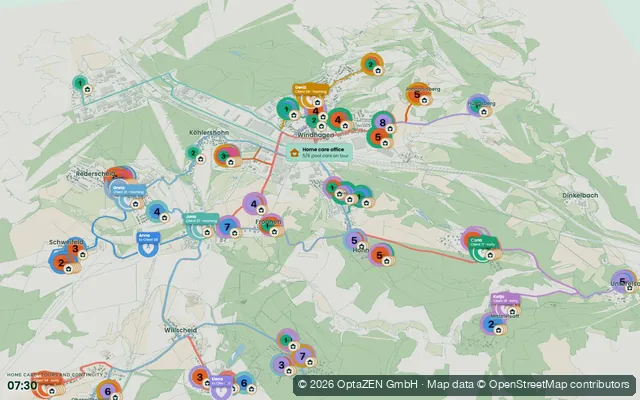
Home care tours and continuity of care
A home care service with 42 clients and 14 carers. One week of tours with morning and evening peaks, split shifts, six pool cars and few different carers per client.
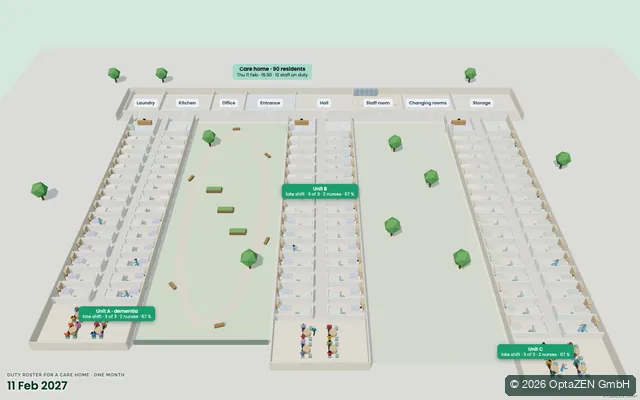
Duty roster care home
A month of early, late and night shifts in three units: enough nurses on every shift, fair weekends, wishes met, and a calm answer when someone calls in sick.

Hospital bed allocation
65 beds in three sections and a busy week of planned and emergency admissions. Every patient should get a fitting bed without waiting in the emergency department.

Operating rooms weekly scheduling
Eight operating rooms, six specialties, a waiting list of 146 patients, a recovery room and ICU beds. The week is planned ahead and re-planned when emergencies arrive.
Rules in the model
What the plan keeps, without anyone checking by hand.
Questions
Frequently asked questions from care.
How does optimized route planning for home care work?
The plan assigns all visits of a week to the carers and sets the order of every route. It keeps visit windows, skills, continuity of care and working hours, and uses real travel times. When something changes, the open part is re-planned.
Can you also plan the roster of a care home?
Yes. For inpatient care the model plans who works which shift in which unit. It keeps the skill ratio per shift, the night minimum, rest times and part-time contracts, and takes requested days off and fair weekends into account.
What is a pattern roster, and how does optimization help with it?
The pattern roster sets the recurring pattern of shifts. Strategically, the optimization builds it itself, as a fair rotation that keeps the skill ratio, working time law and contracts in a standard week. Day to day, it plans the deviations every month for leave, training, wishes and sickness, and stays as close to the pattern roster as possible.
What happens when someone calls in sick in the morning?
Shifts and routes that have started stay fixed. The plan finds a replacement for the rest of the day that keeps every rule, and asks part-timers first who can step in without overtime. That can mean one more change, but nobody ends up above their contract.
Does this replace our care software?
No. Master data, documentation and billing stay in your care software. The optimization computes the plan and is connected to it, so your team keeps working in the tools it knows.
Data protection in care
Time windows, not diagnoses.
Care plans touch health data. That is why we plan with neutral time windows and IDs instead of names, and the solution can run entirely within your IT.