
Planning a week of home care with familiar faces for every client
Which carer visits which client when, in which tour and with which car, so that every visit happens in its window with the right qualification, the working time rules hold, the pool cars suffice in the peaks, and every client sees few, familiar faces over the week?
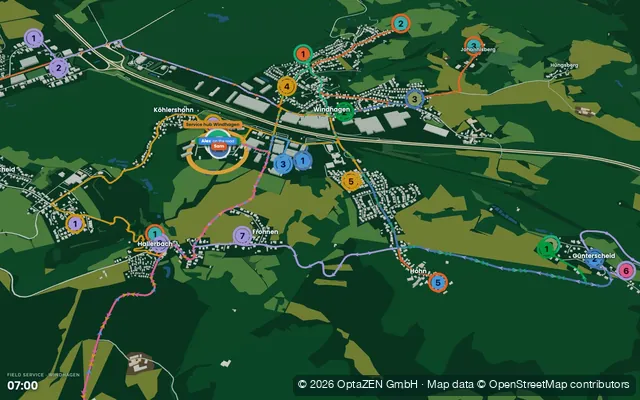
Drag to rotate, right-drag or shift-drag to move the map, scroll or pinch to zoom. The schedule below plays the Wednesday of the plan; hover a bar for details. Plan computed with a Timefold model.
The planning question
A fictional home care service in a rural area looks after 42 clients at home with 14 carers: 6 registered nurses, 4 nursing assistants with the treatment care course and 4 nursing assistants. Most visits fall into two peaks, from 06:30 to 10:30 and from 17:00 to 21:30. A visit bundles the services of the care contract at one time of the day, for example washing, medication and compression stockings in the morning. Treatment care such as insulin, injections and wound care needs a registered nurse. Insulin is due within 15 to 20 minutes around breakfast and dinner. Two clients need two carers at the same time for the patient lift.
The office has six pool cars, four of them electric, for nine carers. The others drive their own car or an e-bike. Many carers work split shifts: an early tour, time off at midday and an evening tour. Today the week is planned on a whiteboard, with a fixed area for each carer.
How we plan it
The Timefold model plans the week of each carer as one list of visits. For every change, the week is simulated: drive times on the real road network by car or e-bike, waiting for windows, the hand-over at the office, breaks and the split into tours. A tour ends at the office when the carer would otherwise wait 90 minutes or more. The pool cars go to the tours in start order, e-cars first if the battery covers the tour. Continuity of care is counted per client and week. Each further carer adds a cost, a carer who has not been to the client in the last four weeks adds more, and the primary carer, the person responsible for the client, is preferred.
The comparison is today's whiteboard plan, computed with the same simulation: each carer has a home area, and visits go in time order to the first carer of the nearest area who has the qualification and is still free. The map and the schedule show the Wednesday, the figures count the whole week. Clients, care plans, staff and the office are fictional. The roads are real.
What the plan shows
| KPI | Optimized plan | Comparison: whiteboard: area tours, first fit |
|---|---|---|
| visits covered (week) | 746 / 746 | 746 / 746 |
| visits after their window | 0 −59 | 59 |
| carers per client and week | 3.3 −2 | 5.3 |
| new faces for clients | 45 −69 | 114 |
| visits by the primary carer | 44 % +4 | 40 % |
| driving time (week) | 84 h −3.6 | 87.6 h |
| hours above contract | 19.3 h −39.2 | 58.5 h |
| working-time rule breaks | 0 −21 | 21 |
Decisions
- carer for every visit of the week, and with it the working days and tours of every carer
- order of the visits in each tour, early, midday and evening tours, split shifts
- pool car for each tour
Constraints
- visit windows: insulin within 15 to 20 minutes around meals, fixed medication times, the client's usual time
- qualification for every service: registered nurse, treatment care course or basic care
- female carers only where the client asks for it, two carers at the same time for the patient lift
- working time act: at most 10 hours a day, a break of 30 minutes after 6 hours and 45 minutes after 9 hours, 11 hours of rest, 48 hours a week, at most 6 days in a row
- contracts, vacation, fixed availability and wishes such as no weekends or no split shifts
- six pool cars for nine carers, hand-over at the office, e-cars charge at their wallbox
Objective
every visit covered on time, few different carers per client and as few new faces as possible, little driving, hours close to the contract, fair weekends
Questions
Where do the data come from?
The roads are real (OpenStreetMap). The office, the 42 clients, their care plans, the staff, the contracts and the history of the last four weeks are generated and plausible. In a project, the visits come from the care software (care plans and service records), the staff data from the duty roster.
Which working time rules are checked?
The German working time act: at most 10 hours of work a day, a break of 30 minutes after 6 hours and 45 minutes after 9 hours, 11 hours of rest between two working days and 48 hours a week. Care services may shorten the rest to 10 hours with compensation, the model uses 11 hours. A company rule allows at most 6 days in a row.
How is continuity of care measured?
Per client and week: the number of different carers, the number of carers who have not been to the client in the last four weeks, and the share of visits by the primary carer.
Can it re-plan during the week?
Yes. Visits that are done stay fixed. A carer who is ill, a client in hospital or a new client are planned around, with the same rules.
More use cases
Your planning problem looks different?
Every operation has its own rules. Tell us about yours. We assess feasibility and expected impact in a free initial call.
Book a free call Write to us