
Bed allocation for a surgical ward
Which bed does each patient get, so that everyone admitted finds a fitting bed and nobody waits in the emergency department?
Result in this example, compared with “Bed chosen at admission by fixed rules”: waiting for a bed 22.1 h instead of 28.1 h.
HospitalsPatient flowHealthcare
Drag to rotate, scroll or pinch to zoom. The schedule below plays the plan; hover a bar for details.
The planning question
The surgical ward of a fictional hospital: 65 beds in two-bed and single rooms, in three sections, with monitored rooms and heavy-duty beds. Over a busy week, planned and emergency admissions arrive for orthopaedics, general surgery and trauma surgery. Planned admissions are known ahead; emergencies only when they arrive. Choosing the first fitting bed at admission works until the rooms fill up. Then two-bed rooms are blocked by gender or isolation, single rooms go to patients who did not need them, and new patients wait in the emergency department.
How we plan it
The plan looks at the whole week ahead and keeps the right rooms free: a single room for an isolation case, a monitored bed for a patient who needs one, matching genders in two-bed rooms. Emergencies are not known in advance, so every emergency starts a new plan from the current state; in this week that happens 71 times.
The comparison chooses the bed at admission by fixed rules, in the same simulated week with the same patients. With the rules 5 patients wait for a bed, 28.1 hours in total; with the plan 4 patients and 22.1 hours, and 91 instead of 90 percent of the bed days are in the own section. The plan moves 4 patients to free a fitting bed, the rules move none. Hospital, patients and lengths of stay are assumptions.
What the plan shows
| KPI | Optimized plan | Comparison: Bed chosen at admission by fixed rules |
|---|---|---|
| patients who waited for a bed | 4 −1 | 5 |
| waiting for a bed | 22.1 h −6 | 28.1 h |
| single-room wishes met | 70 % | 70 % |
| bed days in the own section | 91 % +1 | 90 % |
| patients moved | 4 +4 | 0 |
Decisions
- a bed for every planned admission of the week, in advance
- a bed for every emergency when it arrives, with a new plan from the current state
- at most one move per patient (07:00 to 21:00) when it frees a fitting bed
Constraints
- one patient per bed, 60 min cleaning after discharge
- two-bed rooms: same gender at the same time; isolation patients alone in the room
- bedside monitoring and heavy-duty beds where needed
- own section of the ward, single-room wishes
Objective
a safe allocation first, then as little waiting for a bed as possible, then own section, single-room wishes, few moves and special rooms kept for those who need them
Questions
Does it handle emergencies?
Yes. Emergency admissions arrive around the clock and are only known when they come. Each one starts a new plan from the current state; patients already in bed stay, unless a move frees a fitting bed.
Why does the plan move patients?
A move within the ward can free a single room or a monitored bed for someone who needs it. Each move counts against the plan, and it happens only during the day, at most once per patient.
More use cases

Parcel hub dock scheduling
Overnight trucks, 12 doors, a sorter for 6,000 parcels per hour and 78 van bays. The morning delivery wave has to leave on time.
Warehouse order batching & pick routes
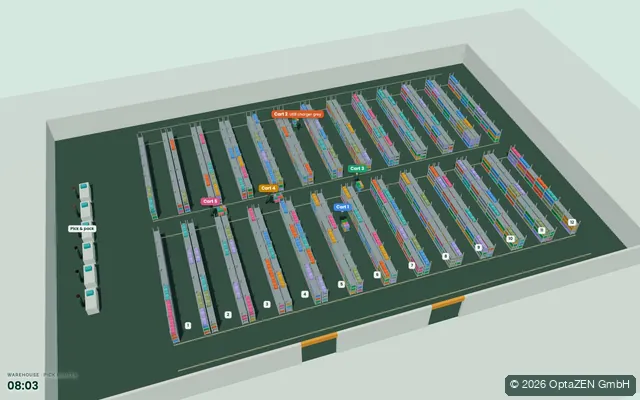
Twelve aisles, 900 articles in chaotic storage, trolleys with several order buckets: shorter walks and faster waves.

Warehouse slotting
400 articles, 624 pick slots on three levels: fast movers near goods out, heavy goods low, the ergonomic level for high volume.
The first step
Where does your planning lose time, capacity or money?
In a free first call we work out which next step is really worth it.