
Workforce schedulingAllocation planning
Dock and crew scheduling in a parcel delivery station
Which crew unloads which truck, at which door and in which order, so that the delivery vans leave on time in the morning?
Result in this example, compared with “first come, first served”: tardiness 92 min instead of 528 min, late tours 23 instead of 44, late parcels 7,315 instead of 12,846.
Parcel & expressCross-dockingRetail logistics
Drag to rotate, scroll or pinch to zoom. The schedule below plays the plan; hover a bar for details.
The planning question
Overnight linehaul trucks unload at 12 doors into a sorter rated at 6,000 parcels per hour, which feeds 78 van bays on three delivery fingers. The vans of the first wave leave at fixed times, a second wave of e-vans follows later. Which truck is unloaded first decides which tours are complete in time.
How we plan it
The model looks at the tours behind every truck. The truck that feeds the earliest tours is unloaded first, which leaves fewer tours late than unloading in arrival order.
What the plan shows
| KPI | Optimized plan | Comparison: first come, first served |
|---|---|---|
| late tours | 23 −21 | 44 |
| late parcels | 7,315 −5,531 | 12,846 |
| tardiness (min) | 92 −436 | 528 |
| truck waiting (min) | 264 −1 | 265 |
Decisions
- door and unloading crew per truck
- unloading sequence
- start time per truck
Constraints
- one truck per door, crews with limited capacity
- sorter throughput
- van departure times per wave
- truck arrival times
Objective
as few late tours and late parcels as possible, short truck waiting times
Questions
Why not first-come, first-served?
Because the trucks carry parcels for different tours. Unloading in arrival order often leaves early tours incomplete while late tours wait full.
Does it work with live arrival times?
Yes. Truck ETAs from telematics update the plan continuously.
More use cases
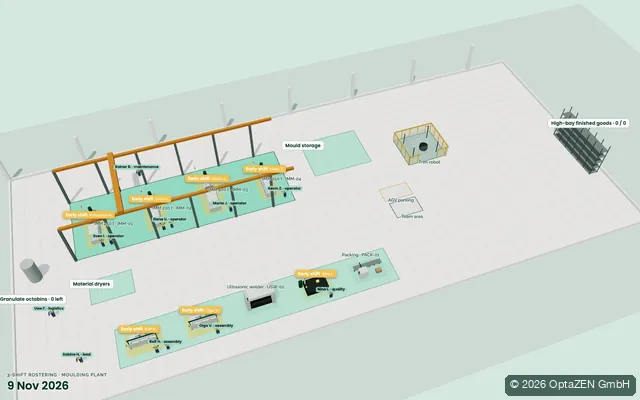
Shift rostering 3-shift production
A month of early, late and night shifts with skills, contracts, vacation, rest rules and wishes. Every shift is covered and the work is shared fairly.
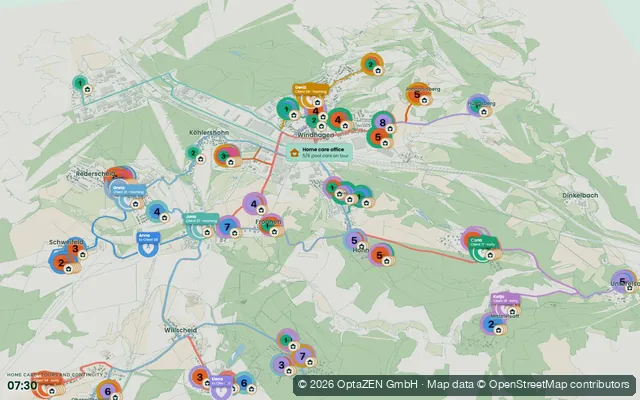
Home care tours and continuity of care
A home care service with 42 clients and 14 carers. One week of tours with morning and evening peaks, split shifts, six pool cars and few different carers per client.
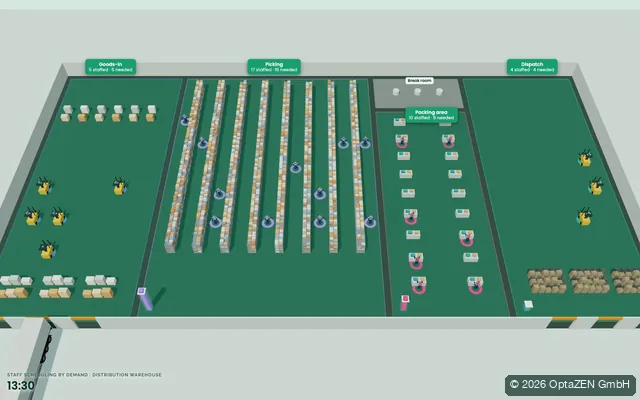
Staff scheduling by demand warehouse
54 people, four areas, one day. Shifts start on the quarter hour and follow the forecast workload in goods-in, picking, packing and dispatch.
The first step
Where does your planning lose time, capacity or money?
In a free first call we work out which next step is really worth it.