
Staffing a warehouse by demand in 15-minute steps
Who works when and in which area of the warehouse, so that staffing follows the forecast workload in 15-minute steps without understaffing or idle time?
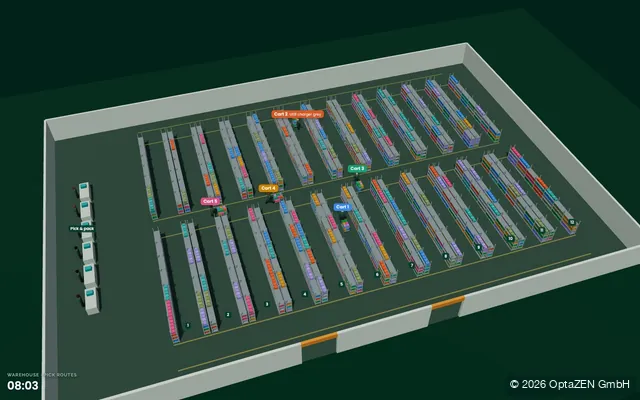
Drag to rotate, right-drag or shift-drag to move, scroll or pinch to zoom. Each area is coloured by its staffing: green fits, amber one person short, red two or more short, grey at least two more than needed. Click a person or an area to find its row in the schedule; hover a bar for details. Plan computed with a Timefold model.
The planning question
A fictional e-commerce distribution warehouse works from 05:00 to 23:00 in four areas: goods-in, picking, packing and dispatch. In the morning twelve inbound trucks are unloaded and put away. Orders are released for picking all day, with the peak between 12:00 and 16:30, because the linehaul trucks leave at 18:00 and a late truck at 21:00. The forecast turns this workload into the number of people each area needs in every quarter hour. On duty are 54 people with different skills: full-timers, part-timers with fixed windows (for example 07:30 to 14:00) and students from 15:00. The classic roster has two shifts, 06:00 to 14:30 and 14:00 to 22:30, with fixed area teams. The demand changes every 15 minutes, the roster every 8 hours.
How we plan it
The Timefold model plans one shift per person: start, working time, break and the area before and after the break. For every area and quarter hour it counts the people present and compares them with the demand. A missing person weighs more than an idle one; working time away from the contract and area switches cost a little. The solver starts from the classic roster and improves it for two minutes.
The comparison is the classic roster: early and late shift with fixed area teams, each team split into early and late by the average demand of its area, breaks staggered in three groups. Parcels on their truck is simulated from each plan: the released parcels pass picking, packing and dispatch in this order, each area handles as many parcels per quarter hour as its people manage, and a parcel counts when it is dispatched before its cut-off.
What the plan shows
| KPI | Optimized plan | Comparison: classic roster · early/late, fixed teams |
|---|---|---|
| understaffed | 4.75 h −62.5 | 67.25 h |
| overstaffed | 24.75 h −81.5 | 106.25 h |
| parcels on their truck | 99.8 % +40.6 | 59.2 % |
Decisions
- start, working time and break of every shift, on the quarter hour
- area before and after the break (at most one area switch per shift, at the break)
Constraints
- demand per area and quarter hour, from the workload forecast
- skills per area: a forklift licence for goods-in and dispatch, training for picking and packing
- shift rules: 4 to 10 hours of work, a 30 minute break after more than 6 hours and 45 minutes after more than 9, working time close to the contract, the availability of each person
Objective
no understaffing, then little idle time, and every parcel on its truck by the cut-off
Questions
Where do the data come from?
The warehouse, the forecast and the staff are fictional and generated. Assumed rates: 30 parcels per picker hour, 48 per packer hour and 120 per dispatch hour; an inbound truck needs 2 people for 45 minutes of unloading and 1 hour of put-away. In a project the forecast comes from the order pool of the WMS and the slot booking for inbound trucks, the staff data from time recording.
What changes against the classic roster?
Understaffing drops from 67 to 5 hours and idle time from 106 to 25 hours. 99.8 % of the parcels reach their truck instead of 59 %. The plan uses 24 start times between 05:30 and 15:30 and 356 instead of 375 working hours, within each person’s flexitime range of 1 hour less to 1.5 hours more per day.
Why is goods-in still short in the morning?
Goods-in and dispatch need a forklift licence. Between 07:30 and 09:15 they need up to 11 forklift drivers together. 14 people hold a licence, and 4 of them are available only from 12:00. The plan leaves goods-in up to 2 people short in this hour; more licences would close the gap.
More use cases

Your planning problem looks different?
Every operation has its own rules. Tell us about yours. We assess feasibility and expected impact in a free initial call.
Book a free call Write to us