
Slotting: where each article should live in a pallet warehouse
Which pick slot should each article get, so that pickers walk less and bend less?
Result in this example, compared with “today's slotting”: bending & reaching 77 min instead of 216 min, picks at ergonomic height 60 % instead of 25 %, metres per order 84 instead of 108.
WholesaleDIY & gardenFood distribution
Drag to rotate, scroll or pinch to zoom. The schedule below plays the plan; hover a bar for details.
The planning question
A wholesale pallet warehouse with 8 wide aisles: three pick levels at the bottom of the racks (the top one needs an order-picker lift), reserve pallets above, goods out at the dock doors. Today the articles are stored by article number.
How we plan it
The model assigns articles to slots against a day of 600 orders, invented for this example, and measures the effect on walking distance on exactly these orders. Almost every article changes slot, and the work of moving them is not in the figures.
What the plan shows
| KPI | Optimized plan | Comparison: today's slotting |
|---|---|---|
| walking per day (km) | 50.5 −14 | 64.5 |
| metres per order | 84 −24 | 108 |
| picks at ergonomic height (%) | 60 +35 | 25 |
| bending & reaching (min) | 77 −139 | 216 |
Decisions
- pick slot per article
Constraints
- slot size and weight limits
- heavy goods on low levels
- articles ordered together close to each other
Objective
short walks per order, fast movers near goods out, many picks in the ergonomic zone
Questions
How often should slotting be re-done?
Typically weekly or with seasonal changes. This example sets no limit on moves. A limit can be added to the model, so that re-slotting fits into one night shift.
Which data is needed?
Article master data (size, weight), the slot list and order history.
More use cases
Parcel hub dock scheduling
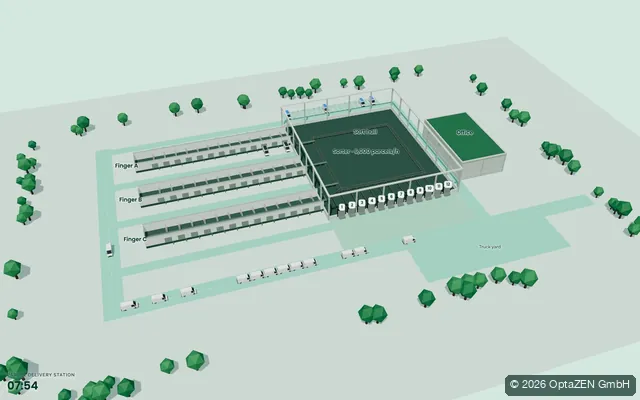
Overnight trucks, 12 doors, a sorter for 6,000 parcels per hour and 78 van bays. The morning delivery wave has to leave on time.
Warehouse order batching & pick routes
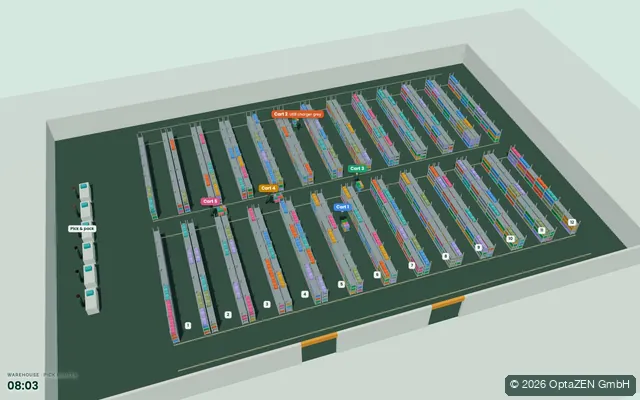
Twelve aisles, 900 articles in chaotic storage, trolleys with several order buckets: shorter walks and faster waves.

Intermodal terminal crane scheduling
Two gantry cranes on one runway, three trains and the trucks of the day. Every train has to leave full and on time, and the trucks should not queue.
The first step
Where does your planning lose time, capacity or money?
In a free first call we work out which next step is really worth it.