
Crane scheduling and load planning in an intermodal terminal
In which order do the two gantry cranes discharge and reload the trains, and which wagon slot gets each export box?
Result in this example, compared with “fixed crane zones · first come, first served · nearest empty slot”: trucks over 30 min 3 instead of 26, truck turnaround 11 min instead of 21 min, longest truck wait 27 min instead of 51 min.
IntermodalContainer terminalsRail freight
Drag to rotate, scroll or pinch to zoom. The schedule below plays the plan; hover a bar for details.
The planning question
The container terminal of a freight village: two gantry cranes share one runway and serve three trains and the trucks of the day. Trains arrive full; imports are discharged after the train is released, exports fill the emptied slots, and every train has to leave full before its cut-off. Trucks come in all day, and some hand over an export and take an import in one visit.
How we plan it
Crane sequencing and the load plan depend on each other, so the model plans them together: which crane takes which lift in which order, and on which wagon slot each export box goes. When one crane is in the way of the other, it moves aside, and that move counts in the plan.
The comparison is common practice, computed for the same day: fixed crane zones, trucks first come, first served, and the crane driver sets an export box on the empty slot nearest the truck. In both plans every box makes its train. With the optimized plan the average truck turnaround on this example day is 11 instead of 21 minutes, and 3 instead of 26 trucks stay longer than 30 minutes. Trains, truck arrivals and lift times are assumptions.
What the plan shows
| KPI | Optimized plan | Comparison: fixed crane zones · first come, first served · nearest empty slot |
|---|---|---|
| truck turnaround | 11 min −10 | 21 min |
| longest truck wait | 27 min −24 | 51 min |
| trucks over 30 min | 3 −23 | 26 |
| gantry travel | 8.1 km −0.2 | 8.3 km |
| boxes late for train | 0 | 0 |
Decisions
- crane and order of every lift (wagon ↔ truck)
- wagon slot for every export box (load plan)
- and with them where the two cranes work over the day
Constraints
- the cranes share one runway, cannot pass each other and keep 40 m apart; a crane in the way makes way
- imports leave the train 20 min after its release; exports go onto emptied or empty slots
- every export on board before the cut-off, every import off before the train leaves
- a double-cycle truck hands over its export before it takes its import
Objective
every train full and on time, then short truck turnaround (target 30 min) and little gantry travel
Questions
Where do the trains, trucks and boxes come from?
Here from an assumed day: train composition, truck arrivals and lift times are plausible but invented. In a project they come from the terminal operating system and the truck appointment system.
Can truck slots be included?
Yes. Truck appointment slots are a natural input and output of the same model.
More use cases
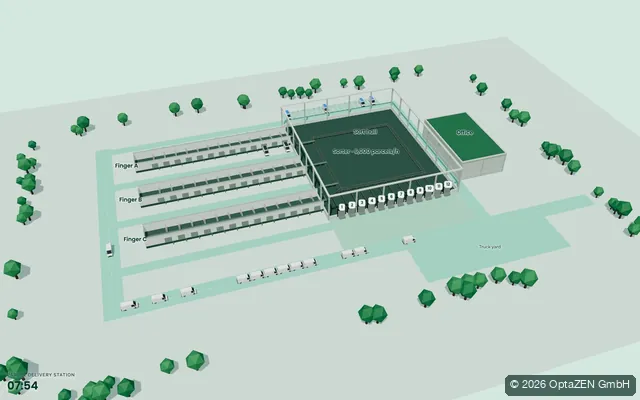
Parcel hub dock scheduling
Overnight trucks, 12 doors, a sorter for 6,000 parcels per hour and 78 van bays. The morning delivery wave has to leave on time.
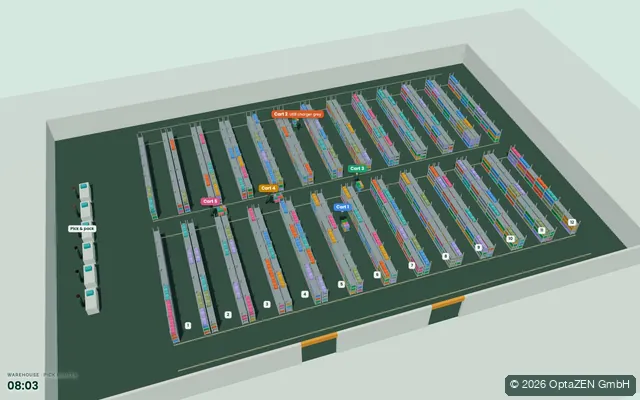
Warehouse order batching & pick routes
Twelve aisles, 900 articles in chaotic storage, trolleys with several order buckets: shorter walks and faster waves.

Warehouse slotting
400 articles, 624 pick slots on three levels: fast movers near goods out, heavy goods low, the ergonomic level for high volume.
The first step
Where does your planning lose time, capacity or money?
In a free first call we work out which next step is really worth it.