
Shift scheduling in production: three shifts, one month
Who works which shift in which role this month, so that every shift is covered with the right skills, contracts and availabilities are respected, and the work is shared fairly?
Result in this example, compared with “spreadsheet · day by day”: unfilled positions 0 instead of 7, wishes met 77 % instead of 17 %, avg. deviation from contract 2.3 h instead of 8.3 h.
ManufacturingProcess industryLogistics centres
Drag to rotate, scroll or pinch to zoom. The schedule below plays the plan; hover a bar for details.
The planning question
An injection-moulding and assembly plant runs 24/7 in three shifts. Each shift needs a shift lead, mould setters, machine operators, assembly, quality inspection, logistics and a maintenance electrician, fewer at night and on weekends. 48 employees cover it, each with their own mix of skills, a contract of 20 to 40 hours a week, vacation and training days, and wishes such as no nights or certain days off. Filling the rota day by day in a spreadsheet leaves gaps late in the month, pushes some people far over their hours and others under, and puts the nights on the same few shoulders.
How we plan it
The model plans the whole month at once: who is needed where, who is available, and how the shifts add up per person. It builds on a standard employee-scheduling model, extended for three-shift production.
What the plan shows
| KPI | Optimized plan | Comparison: spreadsheet · day by day |
|---|---|---|
| positions filled | 100 % +0.9 | 99.1 % |
| unfilled positions | 0 −7 | 7 |
| avg. deviation from contract | 2.3 h −6 | 8.3 h |
| wishes met | 77 % +60 | 17 % |
| night shifts: max − min per person | 7 −3 | 10 |
Decisions
- employee for every position of the month (shift × role)
Constraints
- the role needs the matching skill
- vacation, training and sick days, fixed part-time days
- at least 11 hours of rest between shifts, no early shift after a night
- at most 6 working days in a row, at most 48 hours per week
- monthly hours close to the contract
Objective
every shift covered, hours close to each contract, wishes met, nights and weekends shared fairly
Questions
Can planners still change the roster?
Yes. Shifts can be swapped or fixed by hand; the solver checks the rules and re-plans around the change, for example when someone calls in sick.
Does it respect works-council agreements?
Rules such as rest times, maximum days in a row, night limits or weekend rotation are constraints in the model and can be configured per plant.
Which shift systems suit continuous production?
Round-the-clock production on seven days usually needs four or five shift groups rotating through early, late and night shifts. Which pattern fits depends on rest times, weekend rules, works agreements and wishes. The model plans with any of these patterns and shows how coverage, overtime and fairness compare.
More use cases
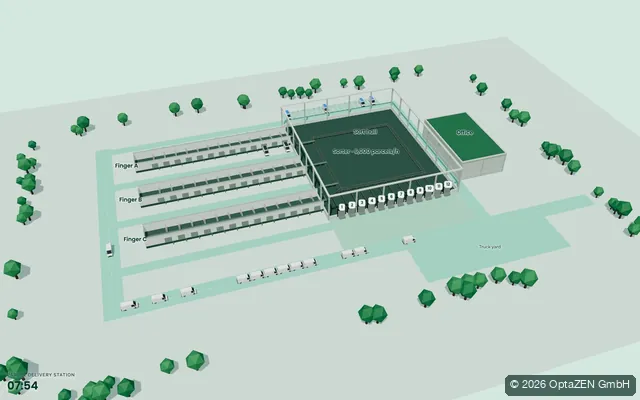
Parcel hub dock scheduling
Overnight trucks, 12 doors, a sorter for 6,000 parcels per hour and 78 van bays. The morning delivery wave has to leave on time.
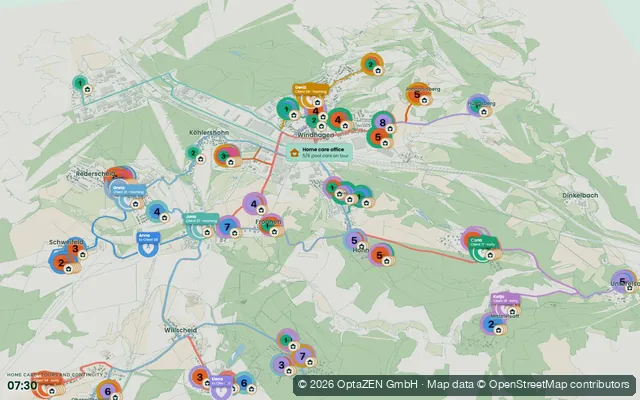
Home care tours and continuity of care
A home care service with 42 clients and 14 carers. One week of tours with morning and evening peaks, split shifts, six pool cars and few different carers per client.
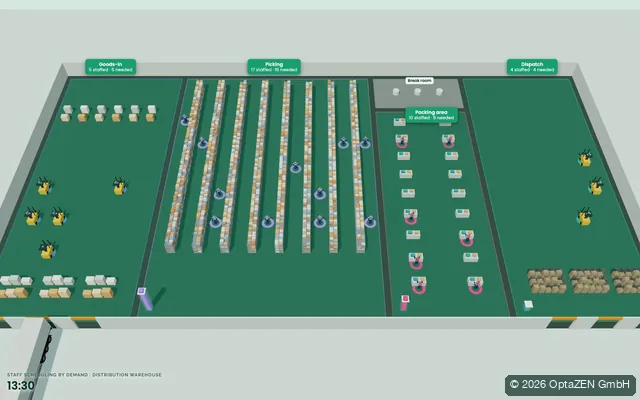
Staff scheduling by demand warehouse
54 people, four areas, one day. Shifts start on the quarter hour and follow the forecast workload in goods-in, picking, packing and dispatch.
The first step
Where does your planning lose time, capacity or money?
In a free first call we work out which next step is really worth it.