
Workforce schedulingAllocation planning
Operating room scheduling for one week, with emergencies
Which patients from the waiting list are operated this week, in which room, on which day and in which order, so that the rooms are used well, overtime and cancellations stay low, recovery room and ICU are not overloaded, and every emergency gets a room in time?
Result in this example, compared with “Block schedule, waiting list order”: ICU overload 0 patient nights instead of 3 patient nights, cancelled on the day 1 instead of 12, emergency waiting 53 min instead of 63 min.
HospitalsSurgical centresHospital groups
Drag to rotate, scroll or pinch to zoom. The schedule below plays the plan; hover a bar for details.
The planning question
The operating suite of a fictional hospital has eight rooms: two with laminar air flow, a hybrid room, a cardiac room and four general rooms, plus a recovery room with ten beds. Six specialties share the rooms by a block schedule. On the waiting list are 146 patients with different urgency.
The week is never as planned: 16 emergencies arrive, and cases run longer or shorter than estimated. A plan that fills every room to the minute leads to overtime and to cases cancelled on the day; a plan that ignores the ICU beds leads to cancellations the next morning.
How we plan it
The model chooses the patients of the week, their room, day and position in the room’s list; from the lists follow the start of every case and the use of surgeons, equipment, recovery room and ICU beds. It plans with estimated durations plus a margin, because surgery often takes longer than estimated. At every emergency, at 12:30 and every morning the plan is made again from the current state: started cases stay, and every change or cancellation counts against the plan.
The comparison is the usual block schedule: every specialty fills its own blocks in waiting list order, does not look at ICU beds or shared equipment, and takes emergencies into its own room. Both run through the same simulated week with the same true durations and emergencies. With the block schedule 119 patients are treated and 12 cases are cancelled on the day; with the plan 138 patients are treated and one case is cancelled, room utilisation is 78 instead of 73 percent, and the ICU is never overloaded (block schedule: 3 patient nights). In both, 14 of 16 emergencies get a room within their limit. Hospital, patients, surgeons and all durations are assumptions.
What the plan shows
| KPI | Optimized plan | Comparison: Block schedule, waiting list order |
|---|---|---|
| OR utilisation | 78 % +5 | 73 % |
| overtime | 464 min −67 | 531 min |
| cancelled on the day | 1 −11 | 12 |
| emergencies in time | 14 / 16 | 14 / 16 |
| emergency waiting | 53 min −10 | 63 min |
| ICU overload | 0 patient nights −3 | 3 patient nights |
| patients treated | 138 +19 | 119 |
Decisions
- the cases of the week: which patients from the waiting list, in which room and on which day
- the order in every room, and with it the start of every case, surgeon, C-arm, robot and laser
- after an emergency, an overrun or in the morning: a new plan from the current state
Constraints
- rooms that fit the procedure (laminar flow, hybrid, cardiac, robot and laser); surgeons on their OR days and in one room at a time
- children and diabetics early, infectious cases last with disinfection; cleaning between cases; one robot, two C-arms, one laser
- recovery room beds and ICU beds per night; elective cases end by 17:00; emergencies within 1, 3 or 8 hours
Objective
no unsafe plan first (rooms, surgeons, ICU, emergency limits, urgent patients this week), then short emergency waits, then patients treated by urgency and waiting time, little overtime, few recovery room waits and few changes to the plan
Questions
Does the plan replace the OR coordinator?
No. It proposes the week and the next day, and it re-plans in seconds when something changes. The coordinator decides, and fixed decisions stay fixed in the next plan.
How are the ICU beds included?
Every patient who needs an ICU bed after surgery counts against the ICU beds of that night. The plan spreads these patients over the week, so that no case has to be cancelled for lack of a bed.
Where would the data come from?
Waiting list, procedures and estimates from the hospital information system, the block schedule and surgeon days from the OR management, bed capacity from bed management. Durations are best estimated per procedure and surgeon from past cases.
More use cases
 06:45
Parcel hub · dock scheduling
Overnight trucks, 12 doors, a sorter for 6,000 parcels per hour and 78 van bays. The morning delivery wave has to leave on time.
 10:30
Shift rostering · 3-shift production
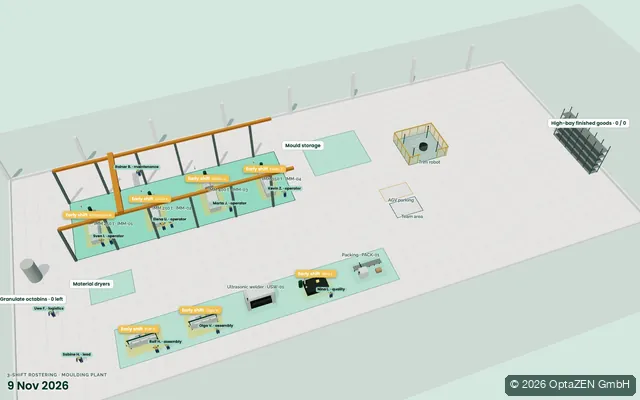
A month of early, late and night shifts with skills, contracts, vacation, rest rules and wishes. Every shift is covered and the work is shared fairly.
 06:30
Home care · tours and continuity of care
A home care service with 42 clients and 14 carers. One week of tours with morning and evening peaks, split shifts, six pool cars and few different carers per client.
The first step
Where does your planning lose time, capacity or money?
In a free first call we work out which next step is really worth it.