
Planning four weeks of practice visits for pharma sales reps
Which rep visits which practice in which week, so that every product is presented to the right specialists often enough, with little driving?
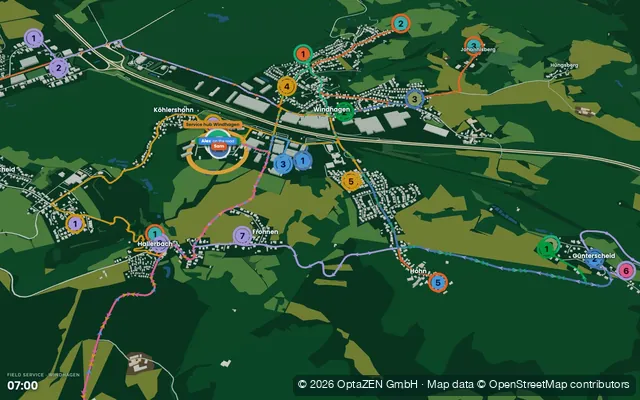
Drag to rotate, right-drag or shift-drag to move the map, scroll or pinch to zoom. The map and the schedule below play one field day, the Tuesday of week 2, with drive times. The ring around each practice shows its target visits of the cycle up to that day. The figures count the whole 4-week cycle. Hover a pin or a bar for details. Plan computed with a Timefold model.
The planning question
Three fictional sales reps of a pharma company cover a rural region and present three product lines: Product A (cardiology), Product B (diabetes) and Product C (respiratory). They visit 80 practices: 46 general practices, 12 cardiologists, 11 diabetologists and 11 pulmonologists. Each specialty has a target per product for a cycle of four weeks, for example Product A four times at a cardiologist. A visit presents at most two products, so a general practice needs 3 visits in the cycle and a cardiology practice 4.
Most practices receive reps only at set times: at the end of the morning session, before the afternoon session, on two fixed mornings or on Tuesdays and Thursdays. The reps start and end every field day at home. Fridays are office days and are not planned here. Today each rep keeps a fixed area and visits the practices whose last visit is longest ago.
How we plan it
The Timefold model plans each field day of each rep as one list of visits. For every change, the day is simulated on the real road network: the rep leaves home so that the first visit starts when its reception opens, drives by car, waits when a reception hour has not begun, takes the lunch break and drives home. A visit must fit completely into a reception hour of that weekday, and two visits to the same practice are at least four field days apart. A target visit that does not fit into the cycle counts as missed, and every further rep at a practice adds a cost.
The comparison is today’s way of working, computed with the same simulation: each rep keeps the practices closest to home and, day by day, visits them in the order of their last visit, adding a practice to the day while its reception hour and the working day allow it. The figures count the whole cycle. Practices, reps, products and reception hours are fictional. The roads are real.
What the plan shows
| KPI | Optimized plan | Comparison: fixed areas, longest since the last visit first |
|---|---|---|
| target visits reached (4-week cycle) | 100 % +23.2 | 76.8 % |
| kilometres per week (4-week cycle, 3 reps) | 854 km −65 | 919 km |
| waiting for reception hours per week (4-week cycle) | 7.5 h −19 | 26.5 h |
Decisions
- rep and day for every target visit of the cycle
- order of the visits on each day
- which products each visit presents (at most two)
Constraints
- target visits per specialty and product in four weeks
- reception hours of each practice for sales reps
- working day from 07:30 to 18:00, from home and back, with driving and a 30-minute lunch break
Objective
every target visit in the cycle, few kilometres, little waiting at practices, one rep per practice
Questions
Where do the data come from?
The roads are real (OpenStreetMap). The practices, their specialties and reception hours, the reps and the products are generated and plausible. In a project, the target lists, visit frequencies and reception hours come from the CRM, the reps’ days off and appointments from their calendars.
Why does the comparison miss targets?
Many practices receive reps only in short slots, for example from 11:00 to 12:30. Working through the area by last visit date fills the days with practices that fit the order, and the short slots of other practices pass unused. Waiting time grows, and some practices do not get all their visits in the cycle.
Can it plan holidays, training days and fixed appointments?
Yes. Days without field work, fixed appointments, events and visits to pharmacies or hospitals are further entries in a rep’s days. The model plans the practice visits around them.
Can a rep change the plan?
Yes. A rep moves or fixes a visit, and the model plans the rest of the cycle again with the same rules. Visits that are already done stay as they are.
More use cases

Your planning problem looks different?
Every operation has its own rules. Tell us about yours. We assess feasibility and expected impact in a free initial call.
Book a free call Write to us