
Winter road service: which truck clears which road, and when
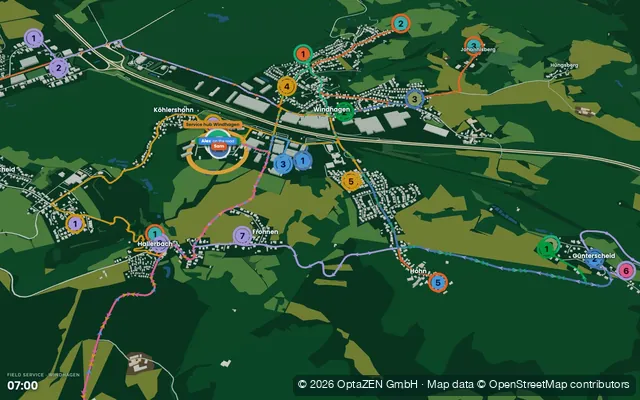
Which spreader truck clears which road in which order after snowfall overnight, so the main roads are clear by 06:00?
Drag to rotate, right-drag or shift-drag to move the map, scroll or pinch to zoom. White roads are still snowy, dark roads are cleared and salted. Hover a road or a bar for details. Plan computed with a Timefold model.
The planning question
Snow starts at 03:30 and falls until about 07:00, about 4 cm in all. The road temperature drops from -1 °C to -6 °C. A fictional municipal depot sends out three spreader trucks with a plough. Two large trucks with 2.5 t of salt each leave at 04:15. A compact truck with 1.2 t leaves at 05:15, because its driver is called later.
The network is 61 km of real roads around Windhagen from OpenStreetMap, cut into 184 road sections. A road section is a piece of street between junctions, up to about 1 km long. Each section has a priority class: main roads and bus routes (29 km) must be clear by 06:00, school routes and collector streets (10 km) by 07:00, residential streets (22 km) by 09:00. Roads with two lanes take two passes, out and back.
Assumptions for this example: ploughing and spreading at 20 km/h on main roads, 15 km/h on school routes and 10 km/h in residential streets, empty driving at up to 40 km/h. The salt rate is 10 g/m² down to -2 °C, 15 g/m² down to -5 °C and 20 g/m² below. A refill at the depot takes 10 minutes. The motorway and farm tracks are not part of the network.
How we plan it
The Timefold model plans each truck as a list of road sections. For every change it follows the tour: the truck enters a section at the nearer end, ploughs and spreads it at the speed of its class and drives back to the depot first when the salt left is not enough for the next section. The salt for a section follows the forecast road temperature at that time. A late section counts by minutes, length and class (main roads three times, school routes twice).
The comparison is a fixed district plan, computed with the same code. The area is cut once into three districts. The largest goes to Spreader 1, the smallest to the compact truck. Each truck clears the main roads of its district first, then the other streets in street order, and refills when the salt runs out. The Timefold plan starts from these tours and improves them for 5 minutes.
What the plan shows
| KPI | Optimized plan | Comparison: fixed district tours |
|---|---|---|
| main and school roads on time | 100 % +11.7 | 88.3 % |
| empty km | 73.1 km −14.3 | 87.4 km |
| salt used | 6.1 t −0.1 | 6.2 t |
Decisions
- truck per road section
- order of the sections on each truck
- when each truck drives back to refill salt
Constraints
- priority classes with deadlines: main roads and bus routes by 06:00, school routes by 07:00, residential streets by 09:00
- salt capacity (2.5 t, compact truck 1.2 t), refill at the depot in 10 minutes
- drivers' working time: at most 6 hours from arrival at the depot
Objective
every road clear by its deadline, then few empty kilometres, little salt and the streets clear early
Questions
Why are roads late in the district plan?
The compact truck starts at 05:15. In its district, the main roads of two villages and several school routes are cleared after their deadlines, 12 % of the main road and school route kilometres. The plan gives part of its district to the large trucks, so all main roads are clear at 06:00 and all school routes at 06:54.
Where do the empty kilometres come from?
A truck drives empty between sections, to refill and back to the depot. A dead-end street costs the way back. The district plan drives 87 km empty, the plan 73 km. Both plans spread the same 97 km of lanes and use about 6 t of salt.
Can the plan follow a new forecast during the night?
Yes. The model is run again with the new snowfall and temperature or without a truck that breaks down. Sections already cleared stay fixed, the open ones are planned again.
More use cases
Your planning problem looks different?
Every operation has its own rules. Tell us about yours. We assess feasibility and expected impact in a free initial call.
Book a free call Write to us