
Workforce schedulingAllocation planning
School timetable and room plan: one week, two buildings
When and in which room does every lesson of the week take place, so that teachers rarely change building, have compact days without long waits and get their wished start and end times, while no teacher, class or room is booked twice?
Result in this example, compared with “Planning board, fixed class rooms”: short teacher days 1 instead of 9, teacher free periods 19 instead of 64, teacher building changes 15 instead of 35.
Schools and school authoritiesVocational collegesUniversities and training centresOrganisations that plan people and rooms across sites
Drag to rotate, scroll or pinch to zoom. The schedule below plays the plan; hover a bar for details.
The planning question
A fictional school teaches grades 5 to 8 in two buildings ten minutes apart on foot, with a sports hall next to house B. Twelve teachers, four of them part-time, teach eight classes; religion and ethics, French and Latin split two classes into two groups. Who teaches which class is fixed; when and in which room each lesson takes place is open. The room plan decides who walks between the buildings, and the timetable decides how long teachers wait between lessons. Both are planned together for one week, with the teachers’ comfort first.
How we plan it
The model gives every lesson a period and a room and weighs teacher comfort against the needs of the classes. It starts from a planning board filled class by class with last year’s fixed class rooms and improves it until all rules hold and the week is as comfortable as possible. Classes then change rooms a little more often than with fixed class rooms; that is the price of fewer walks for the teachers, and a fixed home room can be set as a preference.
What the plan shows
| KPI | Optimized plan | Comparison: Planning board, fixed class rooms |
|---|---|---|
| teacher free periods | 19 −45 | 64 |
| teacher building changes | 15 −20 | 35 |
| short teacher days | 1 −8 | 9 |
| wishes met | 6 / 8 +3 | 3 / 8 |
| class building changes | 32 −7 | 39 |
| class room changes | 119 +12 | 107 |
| main subjects early | 84 % +12 | 72 % |
Decisions
- the day and period of every lesson (double periods start after a break)
- a fitting room for every lesson in either building: class room, lab, computer, art or music room, sports hall
- two rooms in one building for courses that split two classes
Constraints
- no teacher, class or room twice at once
- part-time teachers only on their days or in the morning
- sport only in the hall, science only in a lab
- a change of building only across a long break or a free period
Objective
a pleasant week for every teacher: few changes of building, at most one a day where possible, few free periods, no days with only one or two lessons, part-time hours on few days, wished start and end times; then compact days for the classes with few changes of building and room, main subjects in the morning and an early finish for the younger grades
Questions
Why plan rooms and times together?
Because the room decides where a teacher has to walk next. A good timetable with a poor room plan still sends people across the yard in every break.
Can classes keep their own rooms?
Yes, as a preference. Fixed class rooms are possible, but they cost walks and free periods for the teachers.
What about part-time staff and wishes?
Days off and mornings only are fixed rules. Wished start and end times are weighed against everything else and shown per teacher.
More use cases
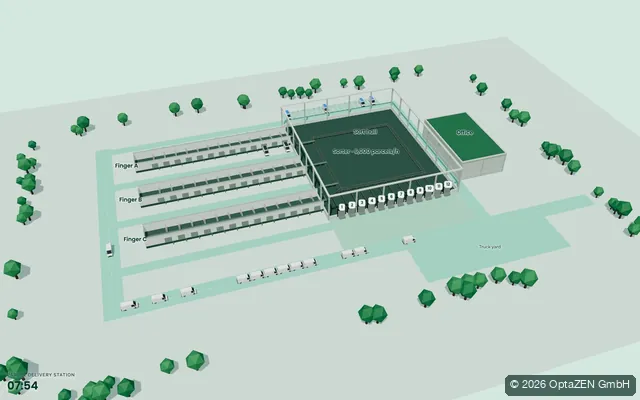
Parcel hub dock scheduling
Overnight trucks, 12 doors, a sorter for 6,000 parcels per hour and 78 van bays. The morning delivery wave has to leave on time.
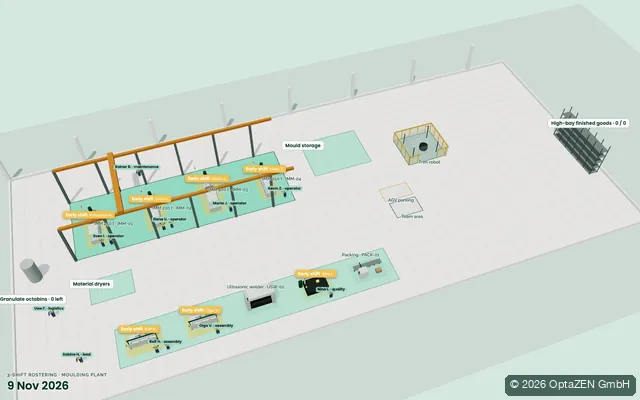
Shift rostering 3-shift production
A month of early, late and night shifts with skills, contracts, vacation, rest rules and wishes. Every shift is covered and the work is shared fairly.
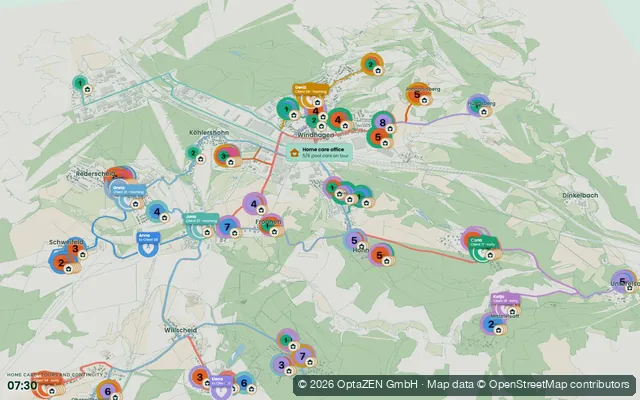
Home care tours and continuity of care
A home care service with 42 clients and 14 carers. One week of tours with morning and evening peaks, split shifts, six pool cars and few different carers per client.
The first step
Where does your planning lose time, capacity or money?
In a free first call we work out which next step is really worth it.