
Workforce schedulingProject and construction scheduling
Recruit training scheduling at a police academy
When, where and with which trainer does every session of every class take place, so that courses run in order and learning goals are reached? And when a speaker cancels the evening before, how is the rest of the week re-planned with few changes?
Result in this example, compared with “Whiteboard, last year's week template”: milestones missed 0 instead of 2, topics behind 2 instead of 6, free hours of classes 3 h instead of 9 h.
Police academiesFire and rescue academiesMilitary and border guard trainingTraining centres with practice at other sites
Drag to rotate, scroll or pinch to zoom. The schedule below plays the plan; hover a bar for details.
The planning question
Basic training at a fictional police academy runs for 26 weeks and is planned in three steps. Before the intake, a template sets the modules, the fixed blocks (exams, qualification shoots, the driving course, ceremonies) and the lesson hours each learning goal needs by each milestone. From it, week plans are made a few weeks ahead, once trainers, speakers and facilities are known. And every day the next days are re-planned when something changes. Today this is often a whiteboard with sticky notes, and one cancelled session pushes others, breaks the order of a course or a booking at the range. The case shows one week of that: three classes on a campus and a training site 40 minutes away by bus with the range and the driving track. A forensic expert calls in sick the evening before, and a storm closes the range the next morning.
How we plan it
The model gives every session of the week a block or next week and a qualified trainer, and checks the week as a whole: course order, fixed blocks, availability, the bus to the training site and the hours each learning goal still needs. After an event the past days stay as they were, fixed blocks stay, and every moved session costs points, most for tomorrow. The comparison is the whiteboard: last year’s week template, with cancelled sessions moved by hand to the next free block, swapped or pushed to next week.
What the plan shows
| KPI | Optimized plan | Comparison: Whiteboard, last year's week template |
|---|---|---|
| learning goals delivered | 124 h of 130 +16 | 108 h of 130 |
| milestones missed | 0 −2 | 2 |
| topics behind | 2 −4 | 6 |
| sessions moved | 12 +6 | 6 |
| free hours of classes | 3 h −6 | 9 h |
| bus trips | 5 +1 | 4 |
| speaker travel | 810 € +380 | 430 € |
Decisions
- block or next week for every session of a course
- trainer or speaker for every session
- with them, when a class takes the bus to the training site
Constraints
- nobody and no facility booked twice
- courses in order, theory before practice; tests and the qualification shoot a day after the sessions they need
- fixed blocks stay; trainers and speakers only on their days
- a change of site only over lunch or a free block
Objective
no learning goal pushed to next week, milestones first; then few free blocks, bus trips and speaker visits; in a re-plan few moved sessions, fewest for tomorrow
Questions
Does it plan the whole programme?
The same model plans the weeks from the programme template. The case shows one week of a 26-week programme, with the goals carried over from earlier weeks.
What happens when a speaker cancels?
The rest of the week is re-planned: a stand-in, swapped sessions or another day. Everything that depends on the session moves with it, in the right order. The plan may move more sessions than a manual fix, in order to keep the milestones.
Does it replace the training coordinator?
No. It proposes a plan with few changes, the coordinator decides, and fixed blocks are never moved without them.
More use cases
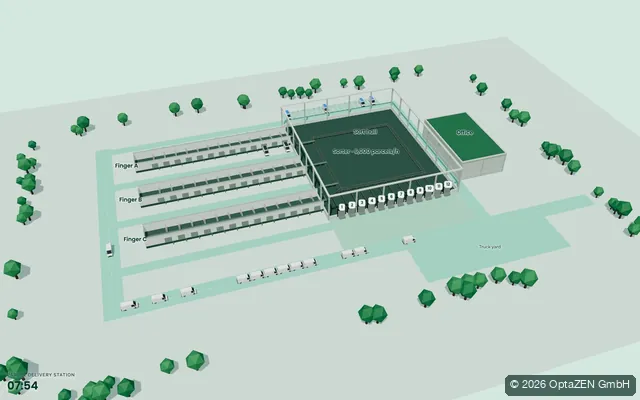
Parcel hub dock scheduling
Overnight trucks, 12 doors, a sorter for 6,000 parcels per hour and 78 van bays. The morning delivery wave has to leave on time.
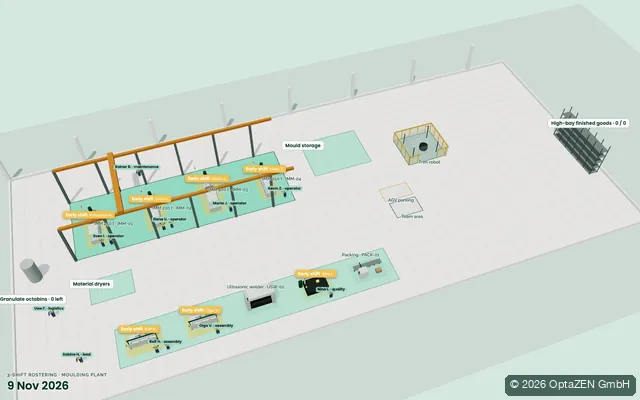
Shift rostering 3-shift production
A month of early, late and night shifts with skills, contracts, vacation, rest rules and wishes. Every shift is covered and the work is shared fairly.
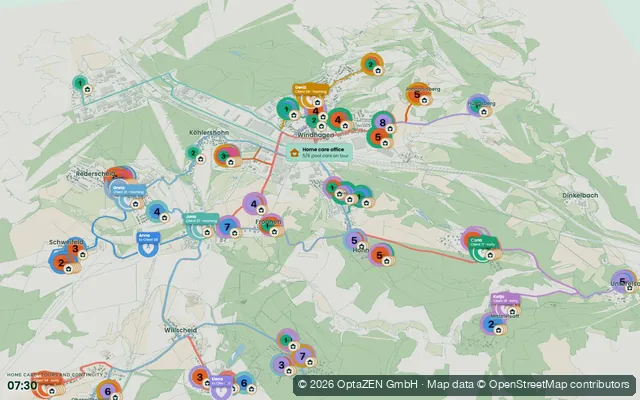
Home care tours and continuity of care
A home care service with 42 clients and 14 carers. One week of tours with morning and evening peaks, split shifts, six pool cars and few different carers per client.
The first step
Where does your planning lose time, capacity or money?
In a free first call we work out which next step is really worth it.