
Duty roster for a care home: one month, three units
Who works which shift on which unit this month, so that every shift has enough staff and enough nurses, the working time act and contracts hold, wishes and weekends are fair, and what changes when a nurse calls in sick?
Result in this example, compared with “pattern roster · filled by hand”: open positions 0 instead of 3, rest times under 11 h 0 instead of 3, staff on more than 2 of 4 weekends 14 instead of 26.
Residential care homesAssisted livingHospital wardsDisability care facilities
Drag to rotate, scroll or pinch to zoom. The schedule below plays the plan; hover a bar for details.
The planning question
A fictional care home with 90 residents in three units, one for people with dementia. Nurses, trained assistants, helpers, activity assistants and a night team, full-time and part-time, each with an hours account. The month starts from the house’s pattern roster and adapts it to vacation, training and wishes. On a Thursday morning a nurse calls in sick for two days, and the next days are planned again from where things stand.
How we plan it
A model of the whole month weighs labour law, skill mix, contracts and wishes together. It is compared with the pattern roster rotated into the month and filled by hand day by day, and with a phone list after the sick call. The comparison planner is good: it keeps rest times and the wish book, but plans day by day without looking ahead. The plan meets more wishes and needs less overtime. It departs from the pattern roster only where that gains more than it costs, since every deviation counts against the plan: so that no shift stays open and no rest time is broken, for wishes met, hours close to the contract and weekends shared more fairly. After the sick call it makes one change more than the phone list, because it asks part-timers first.
What the plan shows
| KPI | Optimized plan | Comparison: pattern roster · filled by hand |
|---|---|---|
| shifts below the skill ratio | 0 −1 | 1 |
| open positions | 0 −3 | 3 |
| hours above contract | 232.6 h −85.2 | 317.8 h |
| wishes met | 90.7 % +14.8 | 75.9 % |
| staff on more than 2 of 4 weekends | 14 −12 | 26 |
| rest times under 11 h | 0 −3 | 3 |
| changes after the sick call | 3 +1 | 2 |
| shifts off the pattern roster | 242 +86 | 156 |
Decisions
- who takes each position of the month: early, late, intermediate, night and activities, per unit
- after a sick call: who steps in, with as few changes as possible
Constraints
- at least half of a shift’s care staff are nurses, and a nurse is in the house at night (house rule following the usual state rules)
- 11 h rest, at most 6 days in a row, 48 h a week
- vacation, training, fixed and approved days off; part-time contracts and the hours account limit
- night blocks with two days off after them
Objective
no open shifts and none below the skill ratio, hours close to the contract, little overtime, wishes met, every second weekend off and weekends shared fairly, familiar faces on the home unit, close to the pattern roster, few changes after a sick call
Questions
Does it replace the pattern roster?
No, it works on two levels. Strategically, the same model can build the pattern roster itself: a fair rotation of early, late and night shifts that meets the skill ratio, the working time act and the contracts in a standard week. Operationally, it handles everything that needs a deviation, such as vacation, training, wishes and sick calls, with the goal of staying as close to the pattern roster as possible. The view shows every deviation.
What happens when someone calls in sick?
The days already worked stay as they are. The next few days are re-planned; part-timers with hours left are asked first, and rest times are never broken.
Which rules apply?
Each state sets its own staffing rules. The model uses the usual 50 % skilled-staff quota per shift, a nurse at night and the working time act; these values can be set per house.
More use cases
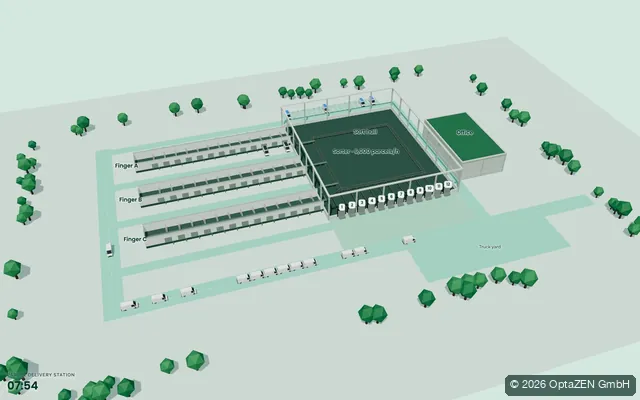
Parcel hub dock scheduling
Overnight trucks, 12 doors, a sorter for 6,000 parcels per hour and 78 van bays. The morning delivery wave has to leave on time.
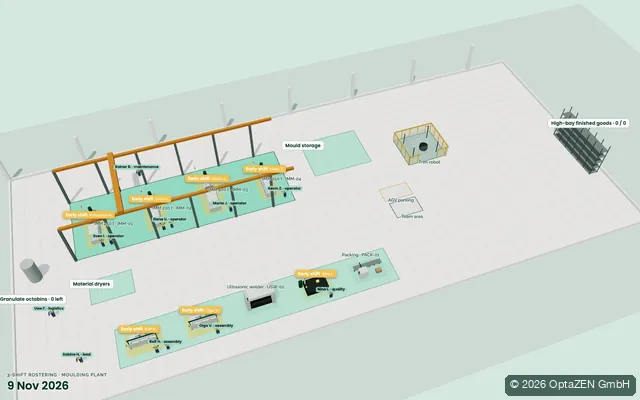
Shift rostering 3-shift production
A month of early, late and night shifts with skills, contracts, vacation, rest rules and wishes. Every shift is covered and the work is shared fairly.
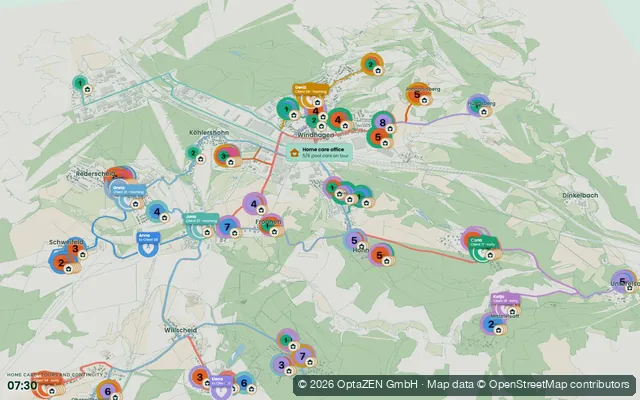
Home care tours and continuity of care
A home care service with 42 clients and 14 carers. One week of tours with morning and evening peaks, split shifts, six pool cars and few different carers per client.
The first step
Where does your planning lose time, capacity or money?
In a free first call we work out which next step is really worth it.