
Flexible staff scheduling for a call centre week
Who works when, on which queue and where, so that the service level holds in every quarter hour of the week, with the labour rules, desks and wishes of the agents, and what changes when an outage or sick calls hit the plan?
Call centresCustomer serviceUtilities and telecomsShared service centres
Drag to rotate, scroll or pinch to zoom. The schedule below plays the plan; hover a bar for details.
The planning question
A fictional customer service centre answers calls for energy and broadband customers on four queues: billing, technical support, sales and contracts, and an English line, Monday to Friday from 07:00 to 21:00. 34 agents with contracts of 20 to 40 hours, skilled on several queues at different levels, and a flex pool of five students share 20 desks on site or work from home.
Calls come in waves over the day and the week. Fixed early, middle and late shifts leave the peaks short and quiet hours overstaffed. On Wednesday a broadband outage triples the technical calls, and on Thursday four agents call in sick.
How we plan it
The model plans the week in quarter hours: for every agent and day the start, length, break and queues, and whether the shift is at home or at a desk. For every quarter hour and queue it computes the expected service level with the Erlang A formula, which also counts callers who hang up. When the outage starts and when agents call in sick, the plan is made again from the current state: shifts that have started keep start and place, a changed start needs one hour’s notice, and the changes are kept few.
The comparison is the usual practice: fixed early, middle and late patterns by headcount, every agent on a home queue, and a team lead who reacts by rule. Both run through the same simulated week. The plan answers 75 instead of 70 percent of calls within 20 seconds, has 1,131 instead of 1,469 abandoned calls, meets two thirds instead of 42 percent of the wishes, and gives nobody more than two late shifts (comparison: five), at almost the same staff cost. The 80 percent target is not reached in this week because of the outage. Centre, agents, calls, handle times, costs and events are assumptions.
What the plan shows
| KPI | Optimized plan | Comparison: Fixed shift patterns |
|---|---|---|
| service level | 75 % in 20 s +5.2 | 69.8 % in 20 s |
| abandoned calls | 1,131 −338 | 1,469 |
| overstaffing | 118.5 h −58.5 | 177 h |
| understaffing | 218.8 h −62.2 | 281 h |
| staff cost | 32,598 € +138 | 32,460 € |
| wishes met | 66.7 % +25 | 41.7 % |
| most late shifts per person | 2 −3 | 5 |
Decisions
- per agent and day: start on the quarter hour or a day off, working time, break, and the queue before and after the break
- home office or a desk on site
- during the week: overtime offers, flex pool call-ins, moved breaks and skill shifts from the current state
Constraints
- calls per queue and quarter hour from the forecast; service level from Erlang A with handle time and patience per queue (target 80 % within 20 s)
- working time act: breaks after 6 and 9 hours, at most 6 hours in a row, 11 hours rest, at most 10 hours per day and 48 per week; contract hours with a flexitime band
- skills and skill levels, availability, 20 desks on site, home-office days per contract
Objective
few calls late or abandoned, hours close to the contracts, little flex pool and overtime, wishes met, late shifts spread fairly, and a calm plan when re-planning
Questions
Why is the service level below 80 percent?
Because of the outage on Wednesday and the sick calls on Thursday. On Monday and Tuesday the plan reaches the target (80.7 and 81.9 percent); on Wednesday and Thursday it is about 69 percent. After the outage report the new plan moves 33 breaks, takes two overtime offers and calls two people in, compared with keeping the old plan, 66 instead of 56 percent of the calls after the outage are answered within 20 seconds.
Does the plan respect the agents’ wishes?
Yes. Wishes such as a late start or a free afternoon are part of the plan, and late shifts are spread fairly. Contract hours, rest times and home-office days are rules, not wishes.
Where would the data come from?
Call history and forecasts from workforce management or the telephony system, contracts and absences from HR, skills from the routing profiles. The plan goes back as shifts and activities per interval.
More use cases
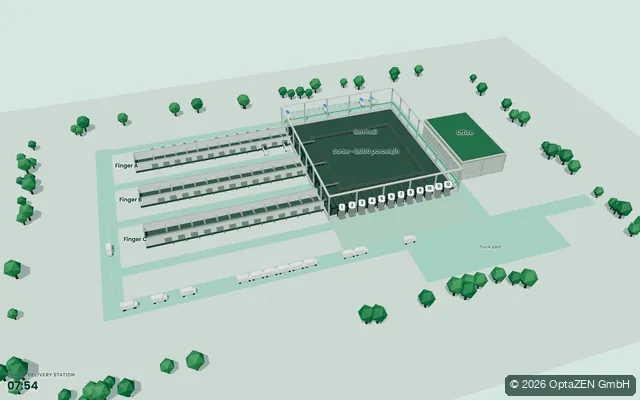 06:45
Parcel hub · dock scheduling
Overnight trucks, 12 doors, a sorter for 6,000 parcels per hour and 78 van bays. The morning delivery wave has to leave on time.
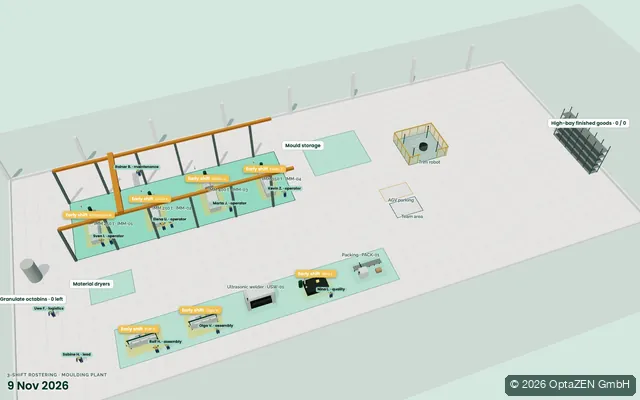 10:30
Shift rostering · 3-shift production
A month of early, late and night shifts with skills, contracts, vacation, rest rules and wishes. Every shift is covered and the work is shared fairly.
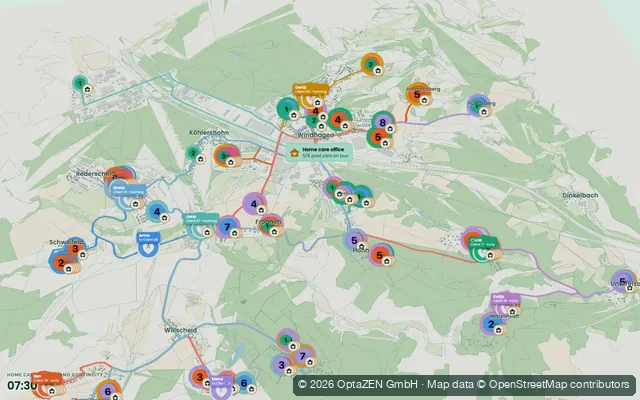 06:30
Home care · tours and continuity of care
A home care service with 42 clients and 14 carers. One week of tours with morning and evening peaks, split shifts, six pool cars and few different carers per client.
The first step
Where does your planning lose time, capacity or money?
In a free first call we work out which next step is really worth it.