
Sequencing a mixed-model assembly line for one shift
In which order do the 400 vehicles of the early shift enter the assembly line, so that no station is overloaded, the paint shop runs in long colour blocks, every unit catches its truck, and the sequence stays calm for the suppliers when a part is missing or a body has to be repaired?
AutomotiveCommercial vehiclesAgricultural machineryMechanical engineering
Drag to rotate, scroll or pinch to zoom. The schedule below plays the plan; hover a bar for details.
The planning question
A fictional plant builds compact electric utility vehicles: flatbeds, tippers, box vans and crew cabs in eight colours, with options such as a large battery, all-wheel drive, heat pump, tow hitch or winter package. In the early shift 400 units go from the paint shop through a body store with 48 places to an assembly line with 32 stations at a takt of 72 seconds, and then to four shipping waves.
The variants need different work at the stations. Two heavy units in a row overload a station: a utility worker has to help, and if none is free, the line stops. The paint shop wants long blocks of one colour, the assembly line wants the heavy variants spread out. Cockpits, battery packs, hydraulic kits and seats come just in sequence, so the next 90 minutes are frozen. At 08:00 the hydraulic kit supplier reports a late truck, at 10:30 six bodies need a spot repair.
How we plan it
The model decides the slot of every unit and checks for every sequence the work at all 32 stations: where the work of a unit does not fit into the takt, the worker drifts into the next station, and where that is not enough, a utility worker is called. It keeps colour blocks long where the line allows it and leaves the paint shop room to pull bodies of the colour in its guns forward. When a part is late or bodies go to repair, the open slots behind the frozen zone are planned again, and every unit moved that the suppliers already know counts against the plan.
The comparison is a rule-based sequencer: wave by wave, colour blocks, spacing rules such as at most one of two units with a heat pump, and after a disruption take out, close the gap and put back at the first slot where the rules hold. Both run through the same simulated shift. The plan calls a utility worker 12 instead of 37 times, the line does not stop, and 393 instead of 383 of the 400 units are on time for their truck, with 50 instead of 49 colour changes. Plant, products, work contents, rules and events are assumptions.
What the plan shows
| KPI | Optimized plan | Comparison: Rule-based: waves, colour blocks, spacing rules |
|---|---|---|
| utility work | 2.1 min −4 | 6.1 min |
| utility calls | 12 −25 | 37 |
| colour changes | 50 +1 | 49 |
| spacing rules broken | 24 −4 | 28 |
| units on time | 393 / 400 +10 | 383 / 400 |
| line stops | 0 min −0.3 | 0.3 min |
Decisions
- the sequence: the slot of every unit on the line, and with it the paint order the paint shop can make from it
- after a shortage or a paint defect: a new order for the open slots behind the frozen zone, from the state at that time
Constraints
- work content per station against takt and station length: where it does not fit, a utility worker steps in; if they are busy, the line stops
- colour changes cost solvent; the guns are washed after 15 bodies of one colour; body store with 48 places
- frozen zone of 90 minutes for the just-in-sequence suppliers; parts and repaired bodies must be there; four shipping waves
Objective
every unit only when its parts and body are there, then few line stops, little utility work, units on time, few colour changes and kept spacing rules; when re-planning, few units moved
Questions
Why not just follow the spacing rules?
Spacing rules are a proxy for the real goal: no station overloaded. The plan checks the work at every station directly, so it can break a rule where the stations cope and keep it where they would not.
What does the frozen zone mean for the plan?
The suppliers build cockpits, battery packs and seats in the order of the sequence. What they already know for the next 90 minutes stays. After a disruption only the slots behind that zone change, and as few as possible.
Where would the data come from?
Orders and variants from the ERP, work contents per station from the industrial engineering data, the body store and line state from the MES. The sequence goes back to the MES and to the suppliers.
More use cases
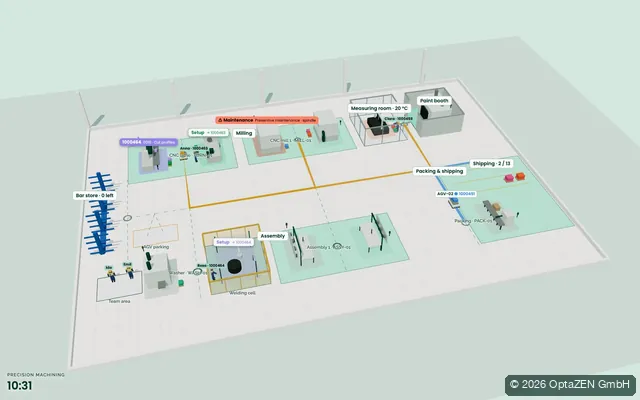 09:20
Production scheduling · machining
CNC mills, lathes, welding and assembly; component orders feed assembly, AGVs move the material, workers in shifts.
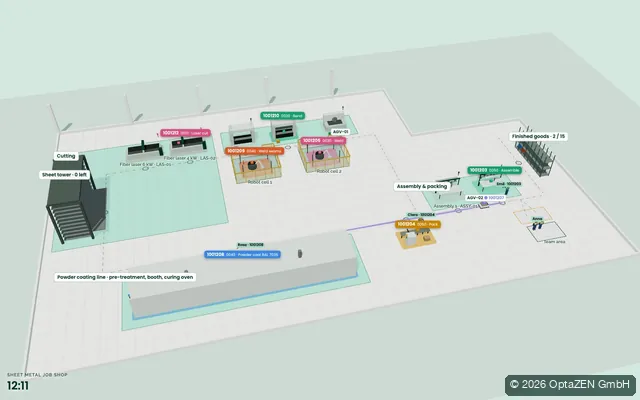 10:00
Production scheduling · sheet metal
Laser cutting, bending, robot welding and a powder coating line that runs in colour batches.
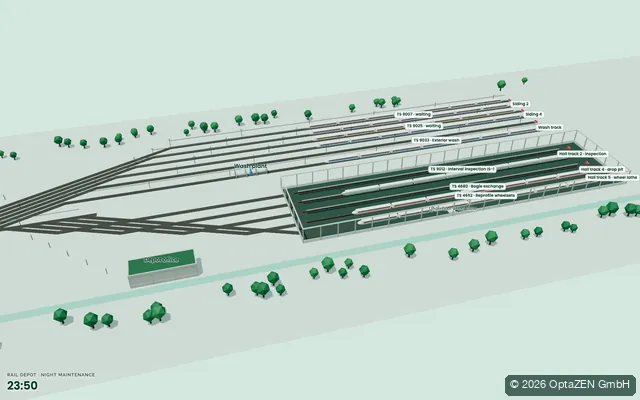 04:00
Rail depot · night maintenance
Wash plant, inspection pits, drop pit and wheel lathe; one shunting crew moves the trains through the switch ladder.
The first step
Where does your planning lose time, capacity or money?
In a free first call we work out which next step is really worth it.