
Night maintenance and shunting in a rail depot
Which train goes to which maintenance track and in which order, and how does the shunting crew get it there?
Result in this example, compared with “arrival order”: shunting conflicts 0 min instead of 30 min, siding overflow 0 min instead of 77 min.
Rail operatorsRolling stock maintenanceInfrastructure
Drag to rotate, scroll or pinch to zoom. The schedule below plays the plan; hover a bar for details.
The planning question
High-speed train sets come in from service in the evening and must be back on the timetable in the morning. Maintenance orders (wash, inspections, drop-pit work, wheel re-profiling) come from the maintenance system. One shunting crew moves the trains through a switch ladder; three sidings buffer trains between jobs.
How we plan it
The model plans maintenance and shunting together, because a free wheel lathe only helps if the train can be moved there in time.
What the plan shows
| KPI | Optimized plan | Comparison: arrival order |
|---|---|---|
| late trains | 1 | 1 |
| late minutes | 37 +35 | 2 |
| shunting conflicts (min) | 0 −30 | 30 |
| siding overflow (min) | 0 −77 | 77 |
Decisions
- maintenance track and start time per work order
- order of the work per train
- shunting moves through the switch ladder
Constraints
- track equipment (wash, pit, drop pit, wheel lathe)
- trains cannot turn between tracks: reverse via a head shunt
- one shunting crew, conflict-free moves
- siding capacity
- departure time in the morning
Objective
trains back in service with as little delay as possible, no shunting conflicts, no siding overflow
Questions
Where do the work orders come from?
Typically from SAP PM or another maintenance system; completed orders are reported back.
What if a job takes longer?
The plan is updated and the following moves and jobs are re-planned.
Are all trains on time in this plan?
No. One train leaves 37 minutes late. The comparison shows only 2 minutes of delay, but its shunting moves overlap for 30 minutes and its sidings are overfilled for 77 minutes, so the night could not run that way. The plan has neither conflict.
More use cases
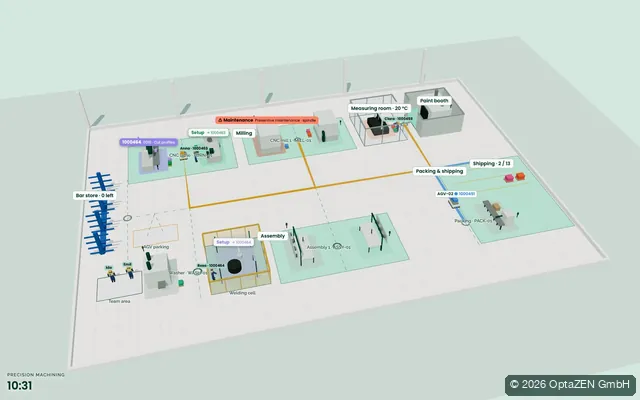
Production scheduling machining
CNC mills, lathes, welding and assembly; component orders feed assembly, AGVs move the material, workers in shifts.
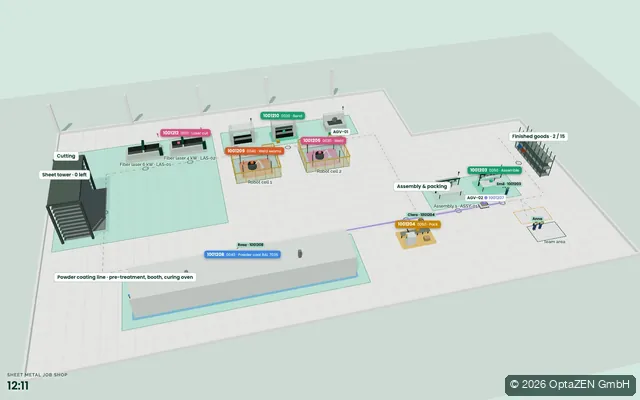
Production scheduling sheet metal
Laser cutting, bending, robot welding and a powder coating line that runs in colour batches.
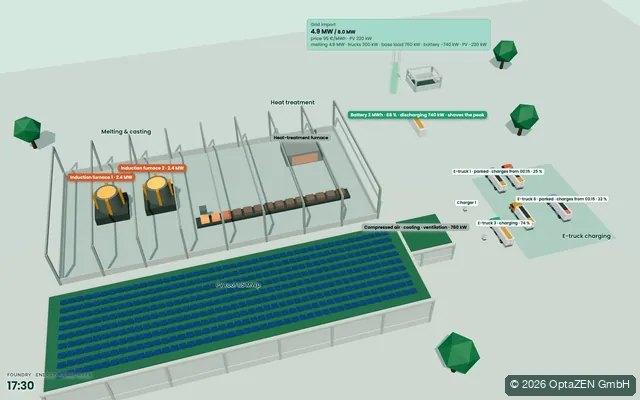
Energy-aware production foundry
Induction furnaces, heat treatment, e-trucks, PV and a battery planned together against day-ahead prices and the 15-minute peak.
The first step
Where does your planning lose time, capacity or money?
In a free first call we work out which next step is really worth it.