
Routing and field serviceProduction and maintenance
One night in an industrial bakery: dough list, ovens and tours
In which order are the doughs kneaded tonight, on which kneader, line and oven, so that every van to the shops and every supermarket truck leaves on time, no dough overproofs, and ovens, cleaning and staff cost little?
Industrial bakeriesFood productionConvenience foodContract manufacturing
Drag to rotate, scroll or pinch to zoom. The schedule below plays the plan; hover a bar for details.
The planning question
A fictional industrial bakery bakes bread, rolls and sweet goods overnight for its own 100 shops and for supermarkets. About 120 dough batches go through seven kneaders, four make-up lines, proofers, three tunnel ovens, two deck ovens and six rack ovens, cooling spirals and the slicing and bagging lines. Ten vans to the shops and five supermarket trucks leave between 01:45 and 05:30.
Dough cannot wait: every product has a bowl rest and a proof window, and overproofed dough is scrap. Ovens change temperature between products, sesame and nuts need an allergen cleaning, rye a cleaning of the line. At 22:30 an order change comes in, at 01:20 the roll line breaks down, and the night has to be planned again from that moment.
How we plan it
The model decides the order of the dough batches and, where there is a choice, the oven group. From this list every step follows: when a batch is kneaded, made up, proofed, baked, cooled and packed, and whether it is ready for its tour. Because the steps are chained by rest and proof windows, a batch that starts too early overproofs and one that starts too late misses its truck. When the order changes or a line fails, the plan is made again from the state at that moment: dough already kneaded goes first, it may move to another line or wait in the cold room.
The comparison is the habit of the bakery, simulated through the same night with the same events: a fixed product order per line in two rounds, the usual oven, extra batches at the end, and after the breakdown the dough list simply goes on. In this simulated night the habit gets 5 of 15 tours out on time and scraps 172 kg of dough; the optimized plan gets 10 tours out on time and scraps none, with the ovens 47 instead of 38 percent busy. Bakery, products, orders, machines and all durations are assumptions.
What the plan shows
| KPI | Optimized plan | Comparison: Habit: fixed product order |
|---|---|---|
| tours on time | 10 / 15 +5 | 5 / 15 |
| tour delay | 143 min −1,050 | 1,193 min |
| dough scrapped | 0 kg −172 | 172 kg |
| oven utilisation | 47 % +9 | 38 % |
| changeovers and cleanings | 83 −14 | 97 |
| staff hours | 156 h −1 | 157 h |
Decisions
- the dough list: order of the batches, and with it the kneader, the make-up line and the start of every step
- the oven group per batch where there is a choice (tunnel, deck or rack ovens)
- after the order change and the breakdown: a new dough list from the state at that time
Constraints
- bowl rest and proof window per product: overproofed dough is scrap
- one batch at a time per kneader, line and oven; oven temperature changes
- allergen cleaning after sesame and nuts, cleaning after rye
- dough makers, line operators and oven bakers in their shifts
- cooling before slicing and bagging; the departure of every tour
Objective
no scrap and no missing goods first, then tours on time (supermarket windows count double), then oven energy, cleaning, changeovers and overtime
Questions
Why are five tours still late?
The breakdown of the roll line at 01:20 takes capacity that cannot be made up before the departures. The plan keeps the delay short: 143 minutes over all late tours, against 1,193 minutes with the habit.
Where would the data come from?
Recipes with rest and proof times from the recipe system, orders from the order system, machines and shifts from production planning. The plan goes back as a dough list for the dough makers and as start times for the lines.
Can the plan react during the night?
Yes. An order change or a machine failure starts a new plan from the current state; batches that are running stay as they are.
More use cases
 07:00
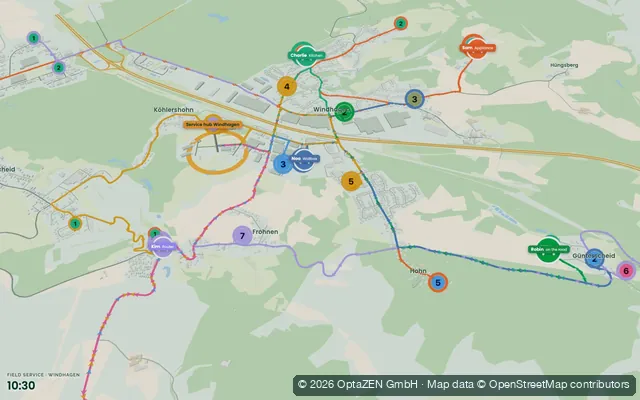
Field service routing
Eight technicians, 29 home installations, arrival windows and skills, planned on the real roads around Windhagen.
 15:00
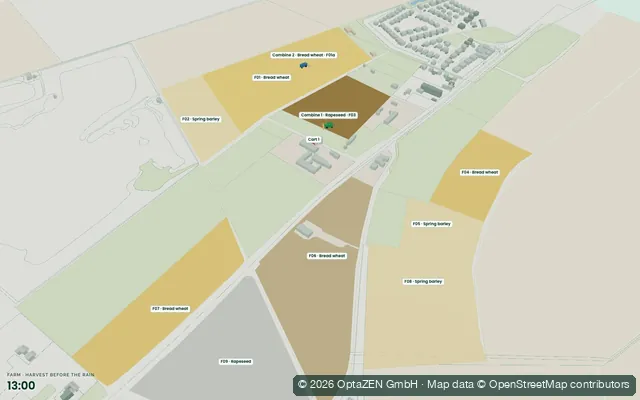
Agriculture · harvest before the rain
Two combines from 10:00, rain from 16:00, two grain carts to the silo. The goal is the most crop value harvested before the weather turns.
 01:00
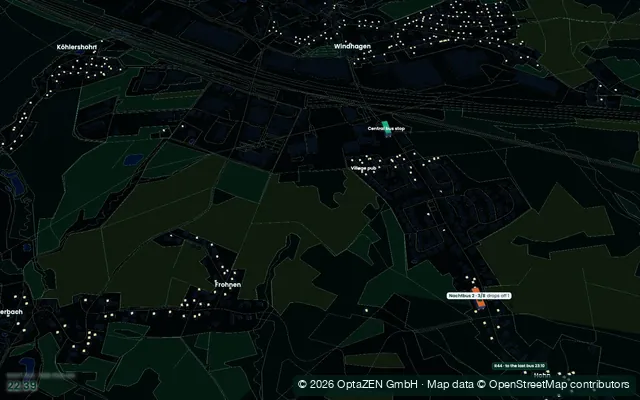
Night bus · ride pooling
Bookings from the last trains, the village pub and between villages. Three minibuses pool the rides home on real roads.
The first step
Where does your planning lose time, capacity or money?
In a free first call we work out which next step is really worth it.