
Stable delivery districts with core and flex zones
How do six drivers share a delivery area so that each one keeps the streets they know and nobody drives through another district, while a day with uneven volume still ends without overtime?
Parcel and courier servicesPostal and letter deliveryRegional delivery companiesMeter reading and field services with territories
Drag to rotate, right-drag or shift-drag to move the map, scroll or pinch to zoom. Solid cells are core cells, striped cells are flex cells; an outline in another colour means a neighbouring driver takes the cell today, a red outline means several drivers. Hover a cell, a van or a bar for details, and switch between the three variants above the map.
The planning question
A fictional delivery base in a rural area sends out six vans, one driver per district. Parcel volumes change from day to day: on the Tuesday shown, one district has 25 % more stops than usual and another one 28 % fewer, while the whole area is close to normal. With fixed districts the busy driver works overtime while the other is back early. With free routing every day the drivers share the work, but they also cross each other’s streets and lose the knowledge of their area. Core and flex zones sit in between: the middle of a district stays with its driver, and only the border may move.
How we plan it
The delivery area is covered by a honeycomb of small cells, each about 0.075 km² (a hexagon of 170 m radius). A cell counts when a household or business lies in it; cells along the roads between villages link them, so a district can be one piece on the street network. Six weeks of history give every cell its daily workload: time at the doors, parking, and reaching the cell.
The first level draws the districts. Every cell gets a district, and the plan looks at the 90th percentile of each district’s daily workload over the history, so that a district fits into the shift on nine days out of ten and not only on an average day. Districts must be in one piece, and short boundaries keep them compact. A stability term charges every cell that leaves the district the drivers know, weighted by its stops. This term is the knob between balance and continuity: with it the districts end within 10 minutes of each other and 11 of 165 cells change district; without it the balance is only slightly better (8 minutes) and 28 cells change. Then the border cells of each district that lie close to a neighbouring district become flex cells, up to a quarter of the district’s usual stops. All other cells are core cells.
The second level plans the day as a routing problem on the real roads. A core stop served by another driver is not allowed. A flex stop may go to a neighbouring driver at a small cost per stop, and every additional driver in the same cell costs much more, so a neighbour takes a whole cell or nothing. Overtime, driver time and kilometres are costs. A fairness term counts every driver’s working day squared, so a long day costs more than two medium ones: moving work from a busy driver to a quiet one pays off, an empty detour does not. The page compares three ways to run the same day: fixed districts (every driver only in the own district), free routing (no districts, planned from scratch) and core and flex zones.
What the plan shows
| KPI | Core and flex zones | Comparison: Fixed districts | Comparison: Free routing |
|---|---|---|---|
| overtime | 1 min −37 | 38 min | 0 min |
| kilometres | 99 km −5 | 104 km | 98 km |
| cells with several drivers | 0 | 0 | 12 |
| stops outside the own district | 16 +16 | 0 | 496 |
Decisions
- the district of every cell of the delivery area (tactical, renewed now and then)
- core or flex for every cell
- on the day: the van and the order of every stop, and which neighbour takes a flex cell
Constraints
- every district is one piece on the street network
- the workload of a district fits the shift on nine days out of ten
- core cells only by their own driver, flex cells by the owner or a neighbouring driver
- cargo space, a 30 minute break, the shift ends at 16:00 and every van is back by 18:30
Objective
little overtime and few kilometres on the day, one driver per cell, and districts that change as little as possible
Questions
Which variant is best?
It depends on the goal, and the table shows all three. Free routing drives the fewest kilometres and brings all drivers back within a quarter of an hour, but drivers cross each other’s streets and most stops are outside the driver’s own district. Fixed districts keep every driver at home, and the busy districts work overtime while the quietest driver is back first. Core and flex zones hand a few border cells to neighbours and keep every cell with one driver. The drivers return between 13:55 and 16:01: the quietest district takes 9 stops from its neighbours, and more is not open to it, because flex cells may only go to neighbouring districts.
Why a percentile and not the average?
A district planned for the average day is too big on every busier day. The 90th percentile of the history means the district fits the shift on nine days out of ten; the flex cells absorb most of the rest.
Why not redraw the districts every week?
Drivers who know their streets deliver faster and make fewer mistakes, and customers know their driver. The stability term lets the plan move only the cells where it really pays off.
Where do the data come from?
The roads and buildings are real (OpenStreetMap). The base, the parcel volumes per household, the six weeks of history, the old district plan and the vans are generated and plausible. In a project, the history comes from the scan data of past tours.
More use cases
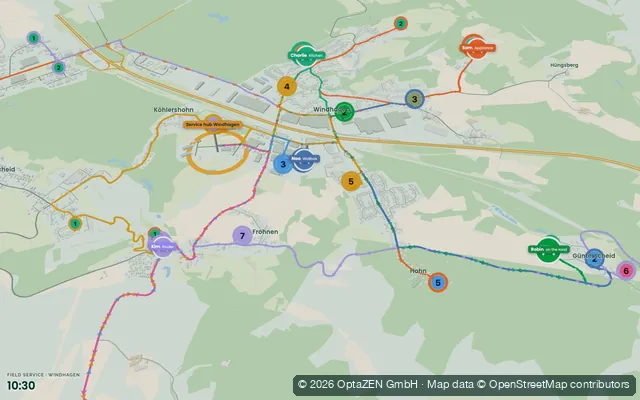
Field service routing
Eight technicians, 29 home installations, arrival windows and skills, planned on the real roads around Windhagen.
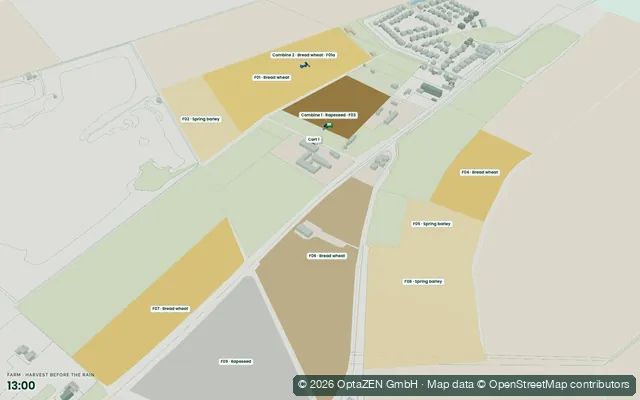
Agriculture harvest before the rain
Two combines from 10:00, rain from 16:00, two grain carts to the silo. The goal is the most crop value harvested before the weather turns.
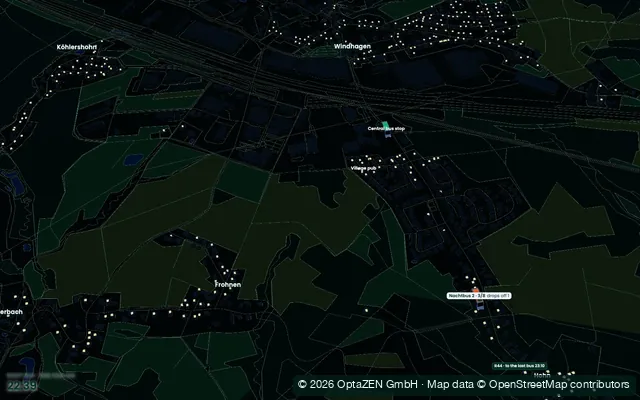
Night bus ride pooling
Bookings from the last trains, the village pub and between villages. Three minibuses pool the rides home on real roads.
The first step
Where does your planning lose time, capacity or money?
In a free first call we work out which next step is really worth it.