
Bus vehicle and crew scheduling: buses and drivers for a school day
Which bus runs which trip, and which driver drives which part of a bus’s day, so that the timetable runs with few buses, few empty kilometres and few paid hours, while every duty keeps the rules for driving time, breaks and duty length?
Result in this example, compared with “fixed buses per line, driver stays on the bus”: paid driver hours 128.6 h instead of 182.4 h, empty km 308 km instead of 406 km, buses needed 14 instead of 17.
Regional and urban bus operatorsTransport authorities and public transport associationsSchool transportDemand-responsive and rail replacement services
Drag to rotate, scroll or pinch to zoom. The schedule below plays the plan; hover a bar for details.
The planning question
A fictional operator runs five regional lines on real roads and real line paths. The lines meet at a shared terminus next to the depot; two of them end at a school centre, two at railway stations. On a school day the 127 trips include extra school trips, which make a sharp morning peak and bring the pupils back at midday and in the afternoon. The plan first decides which bus runs which trip (the vehicle schedule, or block) and then which driver drives each piece of a bus’s day (the duties). Drivers change buses only at relief points: the shared terminus, one stop on the longest line and the depot.
How we plan it
The model plans in two steps, as most operators do. First every trip gets a bus, so that few buses cover the peak and empty runs stay short; a bus may change lines at a shared terminus. Then every bus’s day is cut at the relief points and every piece gets a driver, and each duty is checked against the rules for duty length, breaks and driving time. Both steps start from the usual way of working: fixed buses per line, and every driver stays on one bus all day. The plan needs fewer buses and fewer paid hours. It also has more split duties, and drivers change buses during the day; the comparison shows both.
What the plan shows
| KPI | Optimized plan | Comparison: fixed buses per line, driver stays on the bus |
|---|---|---|
| buses needed | 14 −3 | 17 |
| empty km | 308 km −98 | 406 km |
| paid driver hours | 128.6 h −53.8 | 182.4 h |
| split duties | 8 +3 | 5 |
Decisions
- the bus for every timetabled trip, with the empty runs between termini and the returns to the depot
- line changes of a bus at a shared terminus
- the duty for every piece of a bus’s day between two relief points, with bus changes, breaks and split duties
Constraints
- turn time at every terminus, empty runs on the fastest road path
- drivers change buses only at relief points and need time to get there
- duties last at most 10 hours, split duties at most 12.5 hours, with at most 10 hours of work and 9 hours of driving
- rest breaks by the working time act, and driving interruptions of a sixth of the driving time for regular services up to 50 km
- every duty is paid for at least 5 hours, split duties get a premium
Objective
all rules kept, then the lowest cost of buses, empty kilometres and paid driver time, with few bus changes for the drivers
Questions
Why buses first and drivers second?
It is how most operators work, and it keeps both plans easy to check. The bus plan leaves relief points in every bus’s day, so that good duties are possible.
What is a split duty?
A duty with an unpaid gap of two hours or more, for example to cover the morning and the midday school peak. It is allowed, costs a premium and is counted separately.
Which driving rules apply?
For regular bus services up to 50 km, layovers and other interruptions in the timetable count as driving breaks if they add up to a sixth of the driving time. Rest breaks follow the working time act. Duty length and minimum pay are company rules and can be set per operator.
More use cases
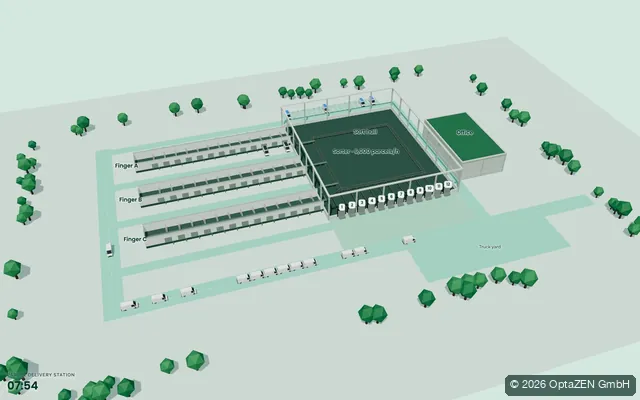
Parcel hub dock scheduling
Overnight trucks, 12 doors, a sorter for 6,000 parcels per hour and 78 van bays. The morning delivery wave has to leave on time.
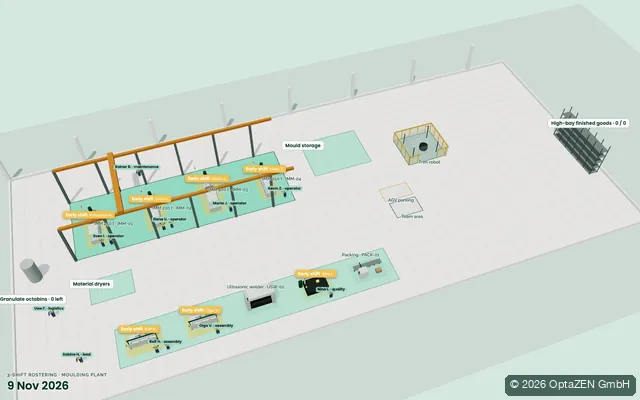
Shift rostering 3-shift production
A month of early, late and night shifts with skills, contracts, vacation, rest rules and wishes. Every shift is covered and the work is shared fairly.
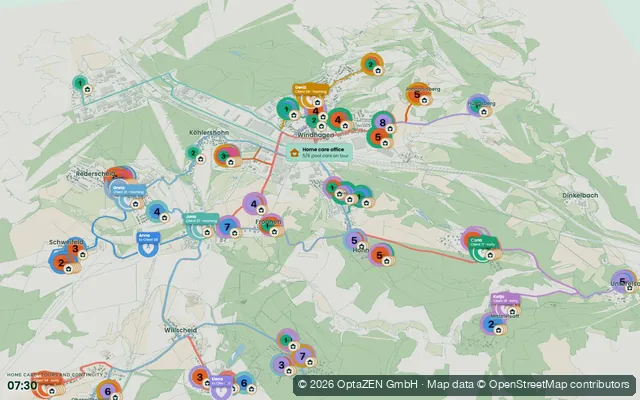
Home care tours and continuity of care
A home care service with 42 clients and 14 carers. One week of tours with morning and evening peaks, split shifts, six pool cars and few different carers per client.
The first step
Where does your planning lose time, capacity or money?
In a free first call we work out which next step is really worth it.