
Production and maintenanceWarehousing, terminals and allocation
Aircraft maintenance in a hangar: task cards, licences and bays
In which order are the task cards of every check worked, by whom, with which tools and in which bay, so that every aircraft is released to service before its next flight with little overtime?
Aircraft maintenance (MRO)AirlinesBusiness aviationHelicopter operators
Drag to rotate, scroll or pinch to zoom. The schedule below plays the plan; hover a bar for details.
The planning question
A fictional maintenance organisation works in one hangar with four bays, one of them for a wide-body. Two aircraft are in the last days of a C-check; every night three aircraft come in from their last flight for an A-check and must be released to service before the first wave in the morning.
Every check is a work package of task cards by zone (engines, landing gear, cabin, avionics, structures and non-destructive testing, flight controls) with a fixed order from tow-in over inspection, repair and close-up to the engine run and the release. Certifying staff with B1, B2 and C licences, mechanics and NDT inspectors work in three shifts; the tow tractor, jack sets, NDT kit, borescopes and the run-up pad are shared. Over three days a brake unit is delayed, an inspection finds corrosion that adds cards, and an aircraft comes in late.
How we plan it
The model decides the order of all open task cards; from this order every card gets its start, its crew by licence and type rating, and its tools, and it waits for parts that are not yet in the store. Crews are not tied to one aircraft: the plan puts licensed staff where the next deadline needs them and counts every move between aircraft within a shift. After each event the plan is made again from the current state, and moved cards and bays count against it.
The comparison is the habit of the hangar: fixed teams per aircraft and shift, cards in card number order, the first free bay, and overtime to finish a card. Both run through the same three simulated days with the same events. With the habit 4 of 10 aircraft are released on time and the delays add up to 13.8 hours; with the plan all 10 are on time, with 9 instead of 65 hours of overtime. In the plan the aircraft stand longer in the bay without work (8.9 instead of 1.3 hours), because the crews move to where the next deadline is. Organisation, aircraft, staff, task cards and durations are assumptions.
What the plan shows
| KPI | Optimized plan | Comparison: Habit: fixed teams, card number order |
|---|---|---|
| aircraft on time | 10 / 10 +6 | 4 / 10 |
| hours late | 0 h −13.8 | 13.8 h |
| licensed staff utilisation | 42 % +9 | 33 % |
| overtime | 9.2 h −55.6 | 64.8 h |
| aircraft idle in the bay | 8.9 h +7.6 | 1.3 h |
Decisions
- the order of all open task cards, and with it the start of every card and the crew by licence and type rating
- the bay of every narrow-body that comes in for an overnight check
- per aircraft whether its staff may work overtime
- after a parts delay, a finding or an inbound delay: a new plan from the state at that time
Constraints
- the order of every work package: tow in, open panels, inspect, repair, close up, duplicate inspection, tow out, engine run, release to service
- B1, B2, C, mechanics and NDT inspectors in three shifts, wide-body type ratings; certifying staff sign for their category
- one tow tractor, jack sets, NDT kit, borescopes, nitrogen carts, one run-up pad; parts only once they are in the store; one aircraft per bay
Objective
every task card staffed first, then aircraft back on time (a wide-body counts more), then little overtime, few people moved between aircraft within a shift and few dock changes; when re-planning also few moved cards and bays
Questions
Why do aircraft stand without work in the plan?
Because the crews follow the deadlines. While an aircraft with a later departure waits, its people help on the aircraft that leaves first. As long as every aircraft is released before its flight, this costs nothing.
How are findings handled?
A finding adds new task cards when the inspection ends, often with a part to order. The plan is made again from that moment: the new cards get crew, tools and a slot, and the other aircraft are disturbed as little as possible.
Where would the data come from?
Work packages and task cards from the maintenance information system, licences and shifts from the staff planning, parts status from the store. The plan goes back as a shift plan per aircraft and as the order of the cards.
More use cases
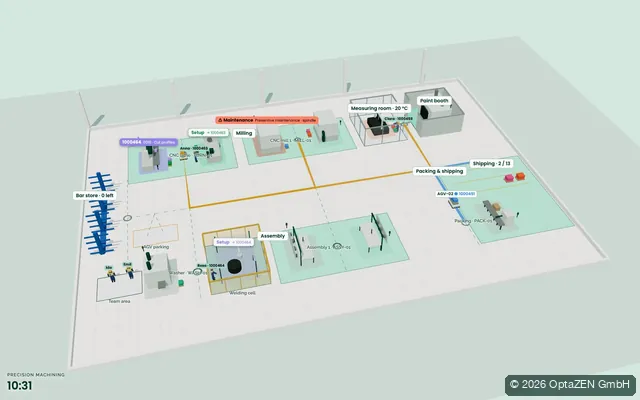 09:20
Production scheduling · machining
CNC mills, lathes, welding and assembly; component orders feed assembly, AGVs move the material, workers in shifts.
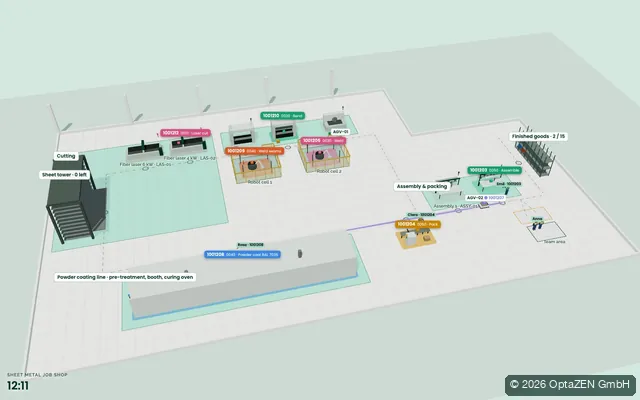 10:00
Production scheduling · sheet metal
Laser cutting, bending, robot welding and a powder coating line that runs in colour batches.
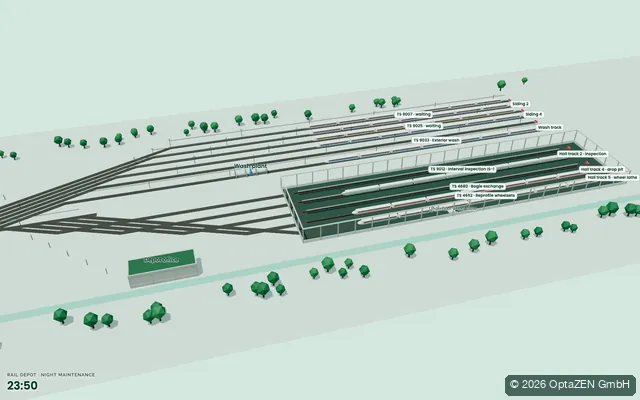 04:00
Rail depot · night maintenance
Wash plant, inspection pits, drop pit and wheel lathe; one shunting crew moves the trains through the switch ladder.
The first step
Where does your planning lose time, capacity or money?
In a free first call we work out which next step is really worth it.