
Industrial 3D printing for medical technology: builds, operators and post-processing in one plan
Which parts go into which build on which printer, when does each build start, and in which order do plates and parts pass the furnaces, wire EDM, CNC, inspection and the operators, so that surgery dates and due dates hold and the printers lose little time, also when a build fails or a machine stops?
Contract manufacturers for medical technologyImplant and instrument makersDental laboratories and milling centresAdditive manufacturing service providers
Drag to rotate, right-drag or shift-drag to move, scroll or pinch to zoom. Each machine has a status light: green printing or busy, amber waiting for an operator, blue powder change or plate change, red down, grey idle. Chips show the OEE of each printer group so far; a purple chip appears at each re-plan. On top of the schedule: the OEE so far, the printers by state, the operators at work against the shifts (orange early, blue late) and the events (red the failed build and the machine stop, purple the re-plans). Switch to the comparison to see the same three days in order of arrival; hover a bar for details.
The planning question
A contract manufacturer for medical technology prints small series in one hall: patient-specific titanium implants for a fixed surgery date, acetabular cups and spinal cages, cobalt chrome knee components and dental frameworks, steel instrument parts, PA12 orthoses and surgical guides, resin guides and dental models. A metal build runs 5 to 23 hours, depending on the layout and how full it is. Then every plate passes a chain of steps: depowdering, stress relief in a vacuum furnace while the parts are still on the plate, wire EDM to cut them off, support removal, CNC for functional surfaces, blasting, cleaning and passivation, CT or a coordinate measuring machine, laser marking and packing in a clean room. Sterilisation is done by an external service.
The printers could run day and night, but people are there only in two shifts, from 06:00 to 22:00. Every start, unload, powder change and manual step needs an operator. A build that ends at 23:00 waits until 06:00, and a change from titanium to cobalt chrome takes about eight hours, five of them cleaning by hand. So the plan times the builds to end when people are there, fills validated plates, avoids powder changes and keeps the post-processing chain flowing. Regulators expect validated builds: positions, orientation and spacing on the plate are part of the validation. A build therefore fills the positions of a validated layout and holds one material, and every patient-specific part stays traceable.
The example is a fictional hall with 41 orders. Three days from Tuesday 06:00 are planned and then simulated: build and step times vary, a CNC machine stops for two and a half hours on Tuesday morning, a build with two patient-specific implants fails on Tuesday afternoon after a recoater collision, and some parts are rejected at the final inspection. Both plans meet the same events. After each event the model re-plans within 20 seconds from the current state. After the failed build it prints the two implants again in a smaller build of their own and moves the cups to the next build, so the surgery date holds. Over the three days the plan keeps all five surgery dates and 33 of 35 due dates (comparison: 2 of 5 and 28 of 35). Printer OEE rises from 41 % to 56 %, the printers lose 36 instead of 103 hours waiting for an operator or a powder change, and 281 instead of 233 good parts are finished.
Optimisation pays at the start of the week, and even more when something goes wrong and the next decision has to be fast. Fast decisions with many dependencies lead to good results only when the rules are clear: qualified printer and material pairs, validated layouts, surgery dates and shifts. All durations here are assumptions for a plausible example: a full metal layout takes 13 to 23 hours, a furnace cycle 9 to 11 hours, a powder change 8 hours, polymer builds cool in the machine at least as long as they print, resin parts are washed for 20 minutes and post-cured for 30, and the expected scrap is 2 to 4 % per printer and material. In a real project the manual step times come from the shop floor.
How we plan it
The model places the lots of every order on the printers. The order of the lots on a printer makes the builds: lots of one material fill the positions of a validated layout until it is full, and a new material starts a new build. The model also sets a priority per order for post-processing. A schedule generation scheme turns this into times in 5-minute steps: a build starts when the printer, the powder and an operator are there, plates and parts take the stations in the order of their priority, the vacuum furnace takes plates of one recipe as a batch, and an attended step has to fit into the shift. Hard rules are the qualified printer and layout and the surgery dates. Then come the minutes late of all other orders, then the OEE losses: printer minutes waiting for an operator, powder changes, build time lost on half-filled plates, and the expected scrap from the validation record of each printer and material. Then lead time. The plan uses the expected durations and keeps a few hours of buffer before due dates.
When a machine stops or a build fails, the model re-plans from the current state. Running builds and finished steps stay as they are. The lost parts become new lots, and the model decides again on printer, build, order and priorities. A small cost for every change against the last plan keeps the plan calm, so the shop floor sees few changes. The CNC stop on Tuesday puts no order at risk, and the plan stays as it is. The failed build is re-planned in 20 seconds: the two implants are printed alone, the cups follow.
OEE is availability × performance × quality. Availability is the time a printer prints or cools, of the time it has work planned. Performance compares the build time that a well-filled layout would need for the same parts with the actual build time. Quality counts the good parts of the parts printed; a failed build and rejected parts lower it.
The comparison is a common way of working: orders in order of arrival, one order per build (a small order takes the next one of the same material along), the first qualified printer that becomes free, a powder change whenever the next order needs it, post-processing first in first out, and a failed build printed again at once on the same printer. Both plans run through the same simulation of the three days. The model gets 3 minutes for the first plan and 20 seconds for each re-plan; each plan is the best one found in that time, without a proof that no better one exists.
What the plan shows
| KPI | Optimized plan | Comparison: Order of arrival, first in first out |
|---|---|---|
| printer OEE | 56.3 % +14.9 | 41.4 % |
| orders on time | 33 / 35 +5 | 28 / 35 |
| printer hours lost | 35.9 h −66.9 | 102.8 h |
| good parts finished | 281 +48 | 233 |
Decisions
- which orders fill which positions of a validated build layout, on which qualified printer
- order and start of the builds on each printer, so that builds end while operators are there and powder changes stay rare
- order of plates and parts at the furnaces, EDM, CNC, inspection and packing, with the operators of each shift; again after every disruption
Constraints
- qualified printer and material, one material and one validated layout per build
- every start, unload, powder change and manual step needs an operator in the shift
- process route per part, stress relief in furnace batches, fixed surgery dates
Objective
surgery dates and due dates first, then printer OEE: no printer waiting for an operator, few powder changes, well-filled plates, low expected scrap; then short lead times and a calm plan
Questions
Is the hall real?
No. The hall, the orders and the people are fictional. The process chains follow common practice in medical additive manufacturing. All durations, rates and scrap figures are assumptions.
What happens when a build fails?
On Tuesday at 13:40 a recoater collision stops a titanium build with two patient-specific implants and a lot of acetabular cups. The model re-plans within 20 seconds from the current state: the two implants get a smaller build of their own on the same printer from 17:40, the cups move to the next build, and the priorities in post-processing change. The implants are packed in time for surgery, and a dental order is on time again as well. The comparison prints the same build again at once, and the implant order on it misses its surgery date.
Why re-plan instead of planning once?
A plan is only as good as the state it starts from. After a failed build or a machine stop the next decisions have to be fast, and they touch many orders at once. The model takes the current state, keeps what has started and decides the rest again within seconds. This works because the rules are clear: qualified printer and material pairs, validated layouts, surgery dates and shifts.
Where do the 67 printer hours come from?
Mostly from timing. The plan orders the builds so that long builds run through the night and end during a shift, and it prefers builds that end while operators are there. The comparison starts the next build whenever a printer is free, so builds end at night and the printer waits until 06:00. The plan also groups the orders by material and changes powder once instead of five times.
Which orders are still late?
Two: the cobalt chrome knee components (45 minutes) and a lot of steel instrument parts (1 hour 40). In the comparison the knee order is almost a day late, and seven orders miss their date in total.
Does the solver re-nest parts freely on the plate?
No. In medical technology the positions, orientation and spacing on the plate are part of the validation. The model fills the positions of validated layouts. A new layout is a validation topic, not a planning decision.
What data does it need?
Orders with process routes and due or surgery dates, the qualified printer and material pairs, the validated layouts with their build times, the step times of the stations, the shift plan, and the current state of printers and stations. Most of it is in the MES or ERP and in the validation records.
What would a pilot look like?
A few weeks of orders and build records calibrate the durations. Then the plan runs next to the current planning, including re-plans after real disruptions, and both are compared on the same weeks before it is used.
More use cases
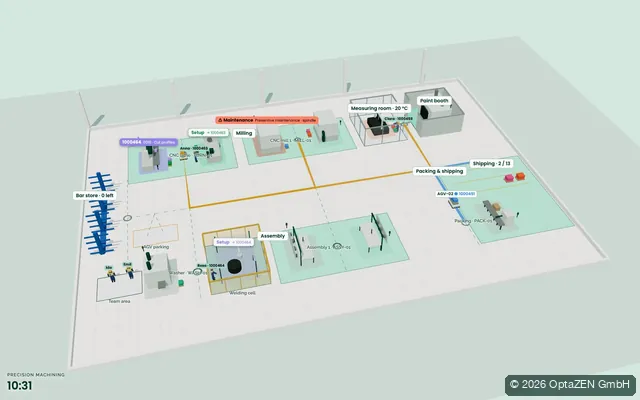 09:20
Production scheduling · machining
CNC mills, lathes, welding and assembly; component orders feed assembly, AGVs move the material, workers in shifts.
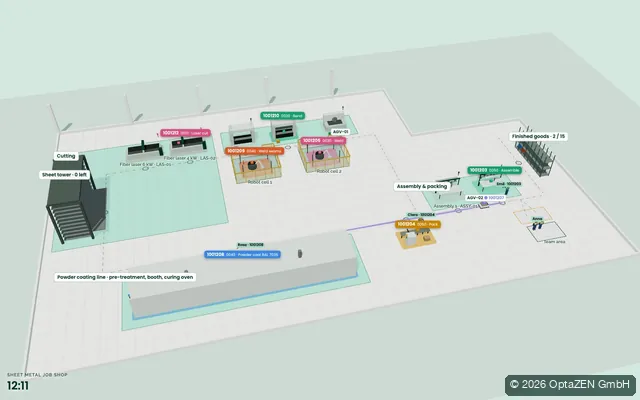 10:00
Production scheduling · sheet metal
Laser cutting, bending, robot welding and a powder coating line that runs in colour batches.
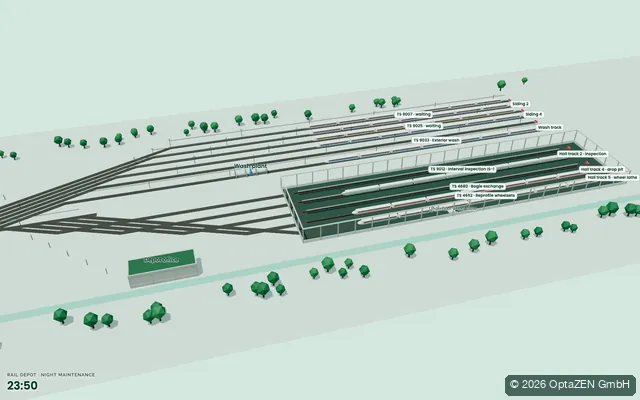 04:00
Rail depot · night maintenance
Wash plant, inspection pits, drop pit and wheel lathe; one shunting crew moves the trains through the switch ladder.
The first step
Where does your planning lose time, capacity or money?
In a free first call we work out which next step is really worth it.