
Wind farm maintenance planning around the weather
Which crew services which turbine and when, inside the weather windows, so that the wind farm loses as little energy as possible?
Wind energyService & O&MUtilities
Drag to rotate, scroll or pinch to zoom. The schedule below plays the plan; hover a bar for details.
The planning question
A real wind farm in the Westerwald with 28 turbines. Over five days, a weather front passes. Three service crews and one mobile crane carry out annual services, blade inspections, oil changes, two main-bearing exchanges and fault repairs. Every stop costs energy: maintenance in calm hours loses little, a faulty turbine loses production until it is repaired, and work at height is only allowed below a wind limit. Faults are not known in advance; they come in as reports during the week.
How we plan it
The plan weighs each hour of work against the energy the turbine would produce in that hour. That is why calm hours are used for services and the storm day stays free. Faults are only known when they are reported, so the plan is made on Monday at 06:00 and made again after each fault report.
The comparison is a common rule, run through the same week with the same reports: fixed areas per crew, turbines in number order, faults and crane jobs first. In this week the gain is small: both repair the faults equally fast, the plan gets all jobs done where the rule leaves one open, and the wind farm loses 57.3 instead of 58.6 MWh. Crews drive on the public roads and on the farm and forest tracks to the turbines. Wind, turbine output and job durations are assumptions.
What the plan shows
| KPI | Optimized plan | Comparison: fixed areas per crew, turbine order, faults and crane jobs first |
|---|---|---|
| lost energy | 57.3 MWh −1.3 | 58.6 MWh |
| fault downtime | 56 h | 56 h |
| jobs not planned | 0 −1 | 1 |
| driving | 6.6 h | 6.6 h |
Decisions
- crew and order of the jobs per crew
- which jobs wait for a calmer day
- slot of the mobile crane for the large exchanges
Constraints
- work at height only below 12 m/s (rope access 9 m/s, crane lifts 8 m/s, fault repairs 14 m/s)
- crews work from 07:00 to 17:00 and drive from the service base
- one mobile crane, on site from Wednesday
- a faulty turbine stays stopped until it is repaired
- a fault is known only from its report; work that has started stays
Objective
little lost energy: services in calm hours, faults repaired fast; few driving hours
Questions
Where does the wind forecast come from?
From a weather service at hub height; the plan is updated when the forecast changes.
Why is the gain small?
In this week most of the lost energy comes from faults, and both approaches repair them as soon as a crew is free. The difference is in the services: the plan puts them into calmer hours and gets all of them done. With more turbines, tighter weather windows or several crane jobs the difference grows.
More use cases
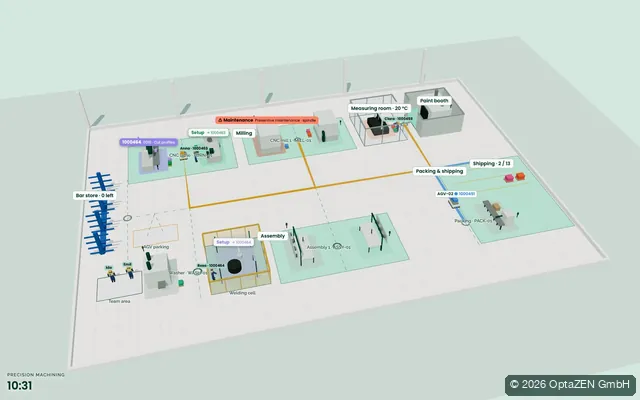
Production scheduling machining
CNC mills, lathes, welding and assembly; component orders feed assembly, AGVs move the material, workers in shifts.
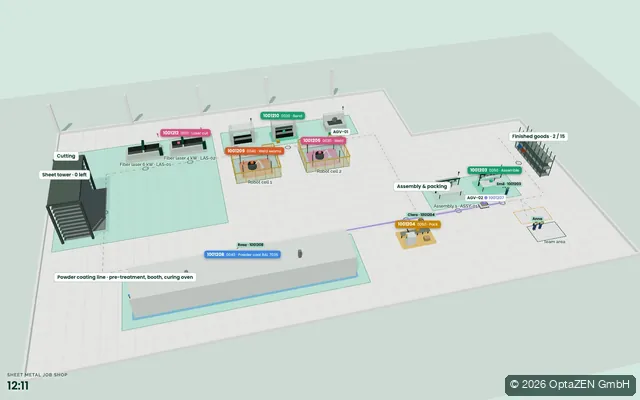
Production scheduling sheet metal
Laser cutting, bending, robot welding and a powder coating line that runs in colour batches.
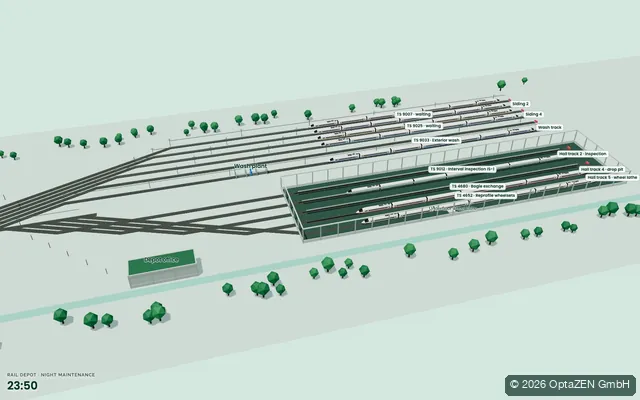
Rail depot night maintenance
Wash plant, inspection pits, drop pit and wheel lathe; one shunting crew moves the trains through the switch ladder.
The first step
Where does your planning lose time, capacity or money?
In a free first call we work out which next step is really worth it.