
Maintenance planning in a plant: work orders in the gaps of production
When does every work order of the next two weeks run, and who does it, so that maintenance uses the gaps of the production plan, the bottlenecks stop as little as possible, no inspection is overdue and open alarms are treated before the machine fails?
ManufacturingAutomotive suppliersMechanical engineeringProcess industry
Drag to rotate, scroll or pinch to zoom. The schedule below plays the plan; hover a bar for details.
The planning question
A fictional plant for drive components machines housings, shafts and gears, hardens them in a furnace and assembles them on two lines, in up to three shifts. Its maintenance team of nine (mechanics, electricians, hydraulics, automation) and four external companies have 82 work orders for the next two weeks: preventive work by date or operating hours with tolerance windows, legal inspections of cranes, pressure equipment and machines, condition alarms whose risk of failure grows, corrective backlog and improvements, some waiting for spare parts.
Maintenance needs the machines to stop, and production needs them too. The production plan has gaps: changeovers, night shifts with little load, Saturdays and a planned furnace stop. On Thursday the gear grinding machine breaks down, and on Monday of the second week an urgent spindle alarm comes in.
How we plan it
The model plans when every order runs and who does it, and it puts the work where the machine is not needed: into changeovers, quiet night shifts, Saturdays and the furnace stop, and it bundles work on the same line into one stop. The bottlenecks (gear grinding, furnace, assembly line 1) stop as little as possible. Each condition alarm carries a failure risk that grows with time, so the plan weighs the cost of an early stop against the expected cost of a breakdown. After the breakdown and the urgent alarm the plan is made again from the state at that time and moves as little as it can.
The comparison plans as many plants do: orders by due date, one fixed technician per area, preventive work in the early shift regardless of production. Both run through the same two simulated weeks; alarms that are not treated fail at their median failure time. The optimized plan costs 78.5 instead of 157 production hours and 7 instead of 31 hours of unplanned downtime. It uses more overtime (66.5 instead of 8 hours) and slightly more external companies, because the gaps are often at night and on Saturdays; in total the two weeks cost about €37,000 instead of €106,000. Plant, machines, orders, people, rates and durations are assumptions.
What the plan shows
| KPI | Optimized plan | Comparison: Due date, fixed technician per area |
|---|---|---|
| production hours lost for maintenance | 78.5 h −78.5 | 157 h |
| unplanned downtime | 7 h −24 | 31 h |
| overdue preventive orders | 1 | 1 |
| risk from open alarms | 871 € −19,022 | 19,893 € |
| technician overtime | 66.5 h +58.5 | 8 h |
| external companies | 4,220 € +640 | 3,580 € |
| cost incl. lost production | 37,474 € −68,383 | 105,857 € |
Decisions
- start of every work order: preventive, legal inspections, condition alarms, corrective backlog, improvements
- the technician for each trade of the order: own mechanics, electricians, hydraulics and automation, or an external company
- after a breakdown or an urgent alarm: a new plan from the state at that time
Constraints
- production plan: shifts, low-load night shifts, changeovers, weekends and the planned furnace stop; units that stop together; furnace cool-down and heat-up
- tolerance windows of preventive work, legal deadlines, spare parts delivery, priority of corrective orders
- skills, shifts, overtime up to 8 h per person and week, booked days of external companies
Objective
legal deadlines and feasible staffing first, then nothing overdue, then the lowest cost: lost production margin, expected failure cost of open alarms, overtime premiums and external companies
Questions
Why does the plan use more overtime?
Because the gaps in production are often at night and on Saturdays. An hour of overtime premium costs far less than an hour of a stopped bottleneck. The plan keeps overtime within 8 hours per person and week.
Where would the data come from?
Work orders, counters and alarms from the maintenance system (CMMS), shifts, changeovers and planned stops from MES and ERP. The plan goes back as scheduled orders with technician and date.
What happens when a machine breaks down?
The breakdown becomes an urgent order, and the open part of the plan is made again from the current state. Work that has started stays, and every change against the previous plan costs a little, so the plan stays calm.
More use cases
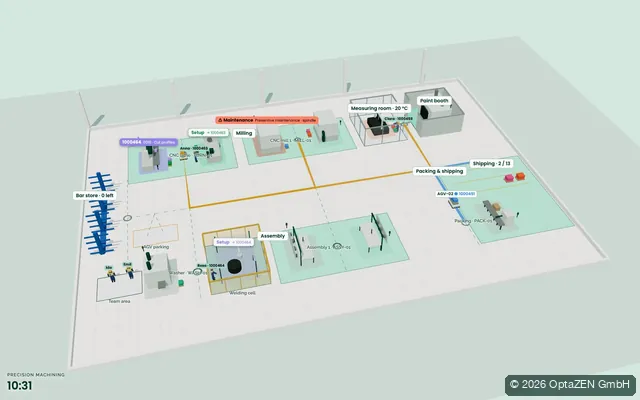 09:20
Production scheduling · machining
CNC mills, lathes, welding and assembly; component orders feed assembly, AGVs move the material, workers in shifts.
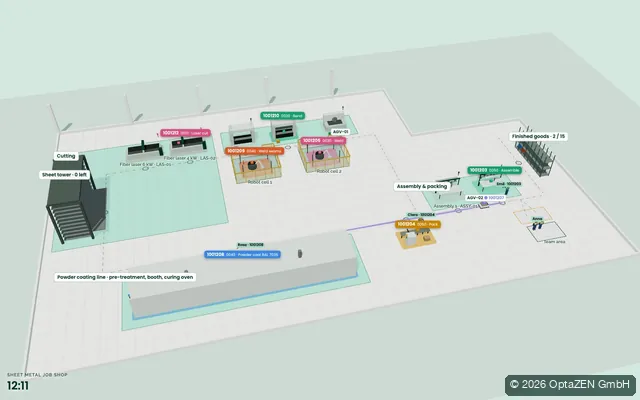 10:00
Production scheduling · sheet metal
Laser cutting, bending, robot welding and a powder coating line that runs in colour batches.
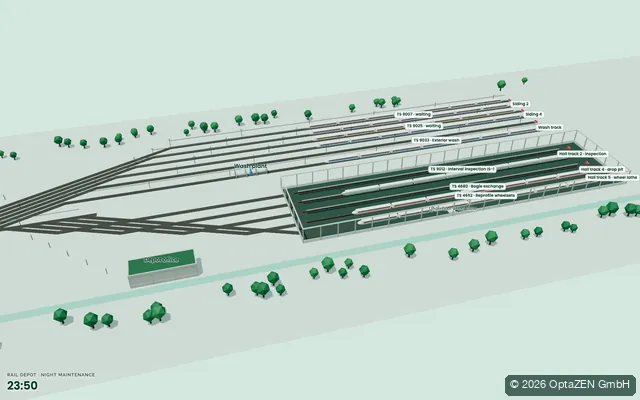 04:00
Rail depot · night maintenance
Wash plant, inspection pits, drop pit and wheel lathe; one shunting crew moves the trains through the switch ladder.
The first step
Where does your planning lose time, capacity or money?
In a free first call we work out which next step is really worth it.