
Route planningCharging optimization
Vision
Autonomous trucks with transfer hubs: a vision for long-haul freight
Vision: a concept with a simulated day and stated assumptions, not a project yet.
How do autonomous trucks on the motorway and local drivers or remote operators at the hubs work together, so that every trailer arrives in its window?
Logistics service providersRetail and consumer goods distributionManufacturing supply chainsLogistics real estate, motorway and charging operators
Drag to rotate, scroll or pinch to zoom. The schedule below plays the plan; hover a bar for details.
The planning question
A concept, not a product: on a fictional 500 km corridor, autonomous electric trucks run between secure hubs at the motorway exits. At the hubs, drivers board or remote operators take over from a control room for the first and last mile. A charging hub halfway tops up the batteries. The motorway is the simplest place for driverless operation and can be approved as a defined operating area; cities, docks and yards stay with people for now. One simulated day shows the trade-off honestly: far fewer trucks and staff hours than today, but time lost at the handovers, which only good planning keeps small. Today’s door-to-door haul with one driver per truck is still faster and meets every window in this day.
How we plan it
What has to be planned: departures on the corridor and arrival slots at the hubs, charging slots under the grid limit, which driver or remote operator takes which arriving truck, trailer swaps and yard places, and re-planning when a truck is late or a link drops; in the long run also where hubs stand and how large they are. A day-planning model covers the whole chain (local legs, corridor, charging, yard). It is compared with first-come-first-served dispatch at the hubs and with today’s long haul, one driver per truck under the driving time rules. All costs, rates and volumes are assumptions; the simulated day is fictional.
What the plan shows
| KPI | Optimized plan | Comparison: Hub model, first come first served |
|---|---|---|
| deliveries in the window | 33 of 42 +13 | 20 of 42 |
| km per truck and day | 1,167 km | 1,167 km |
| cost per load (assumptions) | 664 € −22 | 686 € |
| trucks | 18 | 18 |
| staff hours | 244 h −17 | 261 h |
| trailer wait at hubs per load | 233 min −127 | 360 min |
Decisions
- which driver or remote operator takes which trailer, and in what order (deliveries chained into pickups)
- which autonomous truck hauls which trailer, and with it departure, charging stop and arrival slot at the hub
- re-planning when the corridor closes or a mobile link drops
Constraints
- customer time windows; driver shifts and breaks
- remote operators drive one truck at a time and only in approved zones
- chargers under a grid limit; swap lanes and yard places
- capacity of the technical supervision
Objective
deliveries in their windows, few empty kilometres, little overtime, low energy cost, calm re-plans
Questions
Is this faster to market than full driverlessness?
Very likely. The motorway is the simplest place for autonomous driving and can be approved as a defined operating area. The first driverless hub-to-hub services already run on motorways; cities, docks and yards stay with people for now.
Why does the hub model need more planning than today’s long haul?
Today one driver takes one truck from door to door. At a hub, trucks, chargers, swap lanes, drivers and remote operators are shared and must meet minute by minute. Without planning, trailers wait for hours and windows are missed.
Does remote driving replace drivers?
No. It moves the driver into a control room and works where coverage and traffic allow, such as industrial estates and logistics parks. Elsewhere, a driver boards at the hub.
More use cases
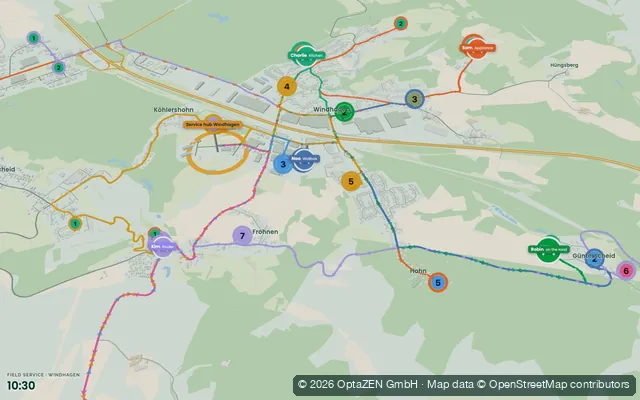
Field service routing
Eight technicians, 29 home installations, arrival windows and skills, planned on the real roads around Windhagen.
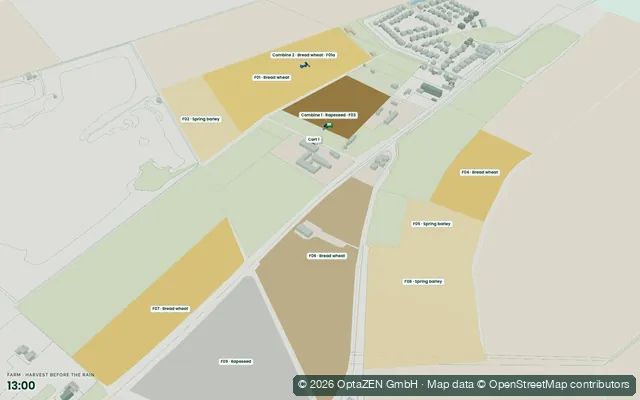
Agriculture harvest before the rain
Two combines from 10:00, rain from 16:00, two grain carts to the silo. The goal is the most crop value harvested before the weather turns.
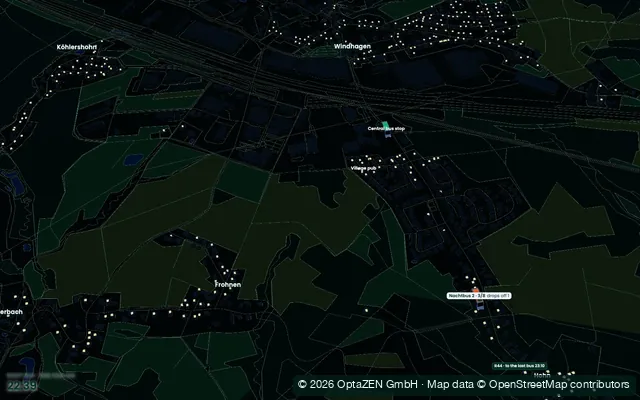
Night bus ride pooling
Bookings from the last trains, the village pub and between villages. Three minibuses pool the rides home on real roads.
The first step
Where does your planning lose time, capacity or money?
In a free first call we work out which next step is really worth it.