
Multi-project planning in plant engineering: shared teams, bays and test stand
In which order do the shared teams, the two assembly bays and the test stand work on eight customer projects, and where does a larger team or a subcontractor pay off, so that factory and site acceptance tests meet their contract dates, liquidated damages stay low and the cash comes in early?
Result in this example, compared with “Order of arrival, own teams”: SAT delay in total 19 days instead of 201 days, liquidated damages 28 k€ instead of 237 k€, penalties, goodwill and extra cost 89 k€ instead of 345 k€.
Plant engineeringSpecial machineryPackaging machineryProcess equipment
Drag to rotate, scroll or pinch to zoom. The schedule below plays the plan; hover a bar for details.
The planning question
A fictional mid-size plant engineering company builds packaging lines, process skids and conveyor systems for its customers. Seven projects run at the start of November, some already in assembly; an eighth, urgent order is won in February. Every project goes through mechanical and electrical design, PLC software, purchasing with long-lead items, welding, panel building and assembly in one of two workshop bays, the factory acceptance test (FAT) on the single test stand, transport, installation, commissioning and the site acceptance test (SAT) at the customer.
The same engineers, welders, fitters, electricians, site fitters and commissioning engineers work on all projects. When each project is planned on its own, they collide: the bays fill up, the test stand becomes the bottleneck, and the late projects pay liquidated damages. On 7 December a supplier announces the robot cell of one line five weeks late, and on 15 February the new order comes in.
How we plan it
The model plans all projects together in working days. It sets the priority of every open work package and chooses, where it pays off, a larger team or a subcontractor; from this follow the start of every step, the use of the bays and the test stand, and the dates of FAT, SAT and the milestone payments. The plan only starts assembly when the parts are there, so a bay is not taken by a machine that waits. After the supplier delay and the new order the plan is made again from the state on that day and moves as little as it can.
The comparison is the usual practice: each project planned on its own with its own team, shared resources first come, first served by order date, levelled again after each event. Both cover the same nine months with the same events. With the usual practice 8 of 16 contract milestones are on time, the SATs are 201 days late in total and the liquidated damages are about €237,000. With the plan 14 milestones are on time, the SATs are 19 days late in total and the damages about €28,000, for about €49,000 of subcontractors and extra effort. Company, customers, people, durations, prices and rates are assumptions.
What the plan shows
| KPI | Optimized plan | Comparison: Order of arrival, own teams |
|---|---|---|
| milestones on time | 14 / 16 +6 | 8 / 16 |
| liquidated damages | 28 k€ −209 | 237 k€ |
| SAT delay in total | 19 days −182 | 201 days |
| cash in by 31 Mar | 4.4 M€ +0.1 | 4.3 M€ |
| subcontractors and extra effort | 49 k€ +49 | 0 k€ |
| penalties, goodwill and extra cost | 89 k€ −256 | 345 k€ |
| assembly bays taken | 30 % −31 | 61 % |
| test stand in use | 20 % +6 | 14 % |
Decisions
- the priority of all open work packages of all projects, and with it the start of every design, workshop, test and site step
- per work package: own team, a larger team or a subcontractor (engineering office, welding shop, panel builder, local installer)
- after a supplier delay or a new order: a new plan from the state on that day; started work stays
Constraints
- order with overlaps: design before purchasing and welding, long-lead items and the control panel before assembly, software before the FAT, transport before installation
- people per team and working day with holidays and the Christmas shutdown; a bay stays taken from the start of assembly until the FAT; one test stand
- lead times of long-lead items and standard parts, transport days, site ready dates of the customers
Objective
lowest cost in euros: liquidated damages (0.5 % per full week of SAT delay, at most 5 %), a goodwill cost per late day, interest on milestone payments against the contract dates, subcontractors and extra effort, and when re-planning few moved work packages
Questions
Why does the plan pay for subcontractors?
Because a week of SAT delay costs more than the extra effort. The plan buys capacity where it removes a bottleneck, for example when several projects need the same team in the same weeks, and leaves it where the own team is in time.
What happens when a new order comes in?
It enters the plan with its contract dates. The plan is made again from the state on that day: started work stays, and moving a customer site date counts three times as much as other changes.
Where would the data come from?
Projects, work packages and dates from the project system or ERP, purchase orders and lead times from purchasing, people and holidays from staff planning. The plan goes back as dates per work package and as a load view per team.
More use cases
 Weeks
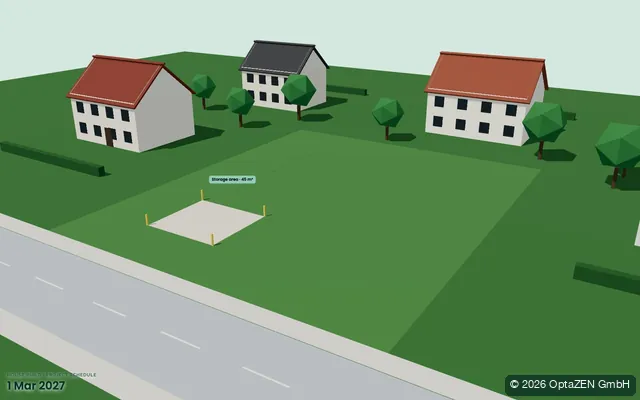
House build · project schedule
A detached house with basement, built by 20 trades from 38 candidate companies with their own calendars. 22 deliveries to a small site, crane and scaffold rented by the day.
 Weeks
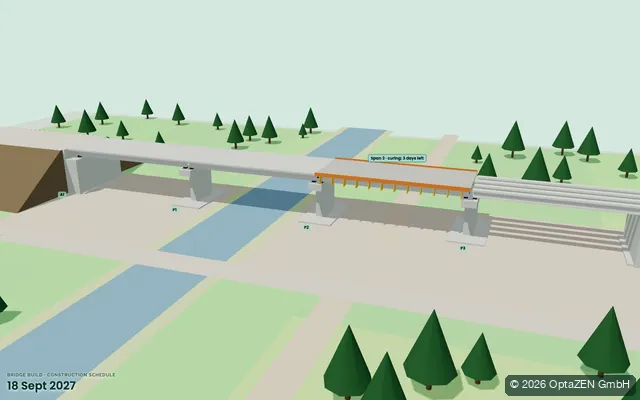
Bridge build · construction schedule
A motorway bridge with 4 spans over a river and a farm road. Two crews, one crawler crane and one deck formwork set, with curing times and a weather calendar.
 21:30
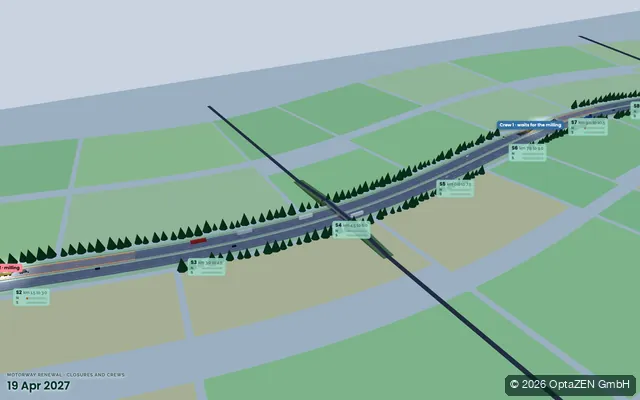
Motorway renewal · closures and crews
A 12 km motorway stretch renewed in 16 work zones. Night closures or weekend full closures, 2 milling machines, 2 paver trains and 1 to 5 asphalt crews compared.
The first step
Where does your planning lose time, capacity or money?
In a free first call we work out which next step is really worth it.