
Delivering stores from a distribution centre with electric trucks
Which truck takes which store orders, in which order and in how many trips, so that every store gets its ambient, chilled and frozen goods in its window, every load fits, and the e-trucks never drop below their reserve?
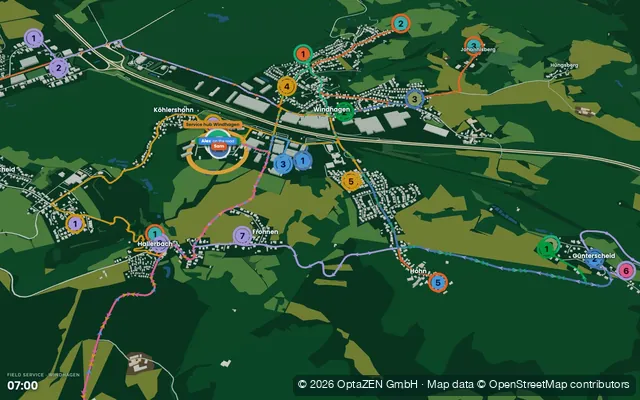
Drag to rotate, right-drag or shift-drag to move the map, scroll or pinch to zoom. The schedule below plays the plan; hover a bar for details. Plan computed with a Timefold model.
The planning question
A regional distribution centre with an ambient hall and a fresh and frozen hall supplies 28 supermarkets in one day. Each store orders pallets and roll cages in up to three temperature zones and takes its empties back; it receives goods only in its delivery window, town-centre stores not before 06:00, some only with a vehicle of at most 12 metres or with a tail lift because there is no ramp. The fleet has eleven trucks: diesel and battery-electric semi-trailers with 33 pallet places, rigid trucks with 18, some with multi-temperature trailers and movable bulkheads. An electric truck uses more energy with a heavy load, on the motorway and with its cooling unit running, so its range depends on the tour. Today the tours are cut into sectors, ambient and fresh goods travel separately, and e-trucks only get short tours.
How we plan it
The Timefold model plans each truck’s day as one list: order parts and returns to the DC, which split the day into trips. For every change, the whole day is simulated: drive times on the real road network, waiting for windows, breaks, unloading and the loading plan of each trip, filled from the front so the first stop’s pallets are at the doors. From the payload left after every stop the model computes the energy of the next leg; the battery is charged while the truck is reloaded, at stores with a charger, or in a longer charging stop when power is cheap. The comparison is today’s dispatching, computed with the same simulation: sector tours, ambient and fresh separate, diesel first, e-trucks only on tours that need at most half the battery.
What the plan shows
| KPI | Optimized plan | Comparison: sector tours, ambient and fresh separate, diesel first |
|---|---|---|
| pallets on own trucks | 433 / 433 | 433 / 433 |
| trucks used | 8 / 11 −3 | 11 / 11 |
| truck kilometres | 1,609 km −1,125 | 2,734 km |
| kilometres electric | 73 % +33 | 40 % |
| CO₂ (well to wheel) | 0.9 t −0.9 | 1.8 t |
| cost of the day | 4,132 € −2,868 | 7,000 € |
| store deliveries | 35 −26 | 61 |
Decisions
- truck and trip for each order part (ambient, chilled, frozen)
- stop order of each trip, and with it the loading order (last stop loaded first)
- which tours run electric, how many trips per truck
- where and when e-trucks charge: while reloading at the DC, a longer charging stop at cheap hours, at stores with a truck charger
Constraints
- store delivery windows, early-morning limits in town centres
- pallet places including the empties taken back, payload
- temperature zones only on trucks with those compartments, up to three behind movable bulkheads
- store access: maximum vehicle length, ramp or tail lift
- drivers: at most 10 hours, 45-minute break after 4.5 hours of driving
- battery never below the 15 % reserve; energy from payload, road type and cooling unit; DC chargers and their power
Objective
every order on own trucks, few trucks and kilometres, low cost for drivers, electricity by time of day, diesel, toll and CO₂, one delivery per store where possible
Questions
Where do the data come from?
The roads and the store sites are real (OpenStreetMap); the distribution centre, the orders, the fleet and the prices are generated and plausible. In a project the orders come from the ERP or WMS, the fleet and the charging data from telematics and the charging system.
Is the loading plan really checked?
Yes. Each trip gets a loading plan in rows of three Euro pallets: compartments front to back, the last stop loaded first, beverage pallets never stacked. Empties taken back need room.
How is the range of an e-truck modelled?
Energy per kilometre grows with the payload, with motorway speed and in stop-and-go; the cooling unit draws from the battery while chilled or frozen goods are on board. The model knows the charging curve, the chargers at the DC and the prices by time of day, and it never lets the battery drop below the reserve.
Can it re-plan during the day?
Yes. Tours that are already on the road stay fixed; late orders, a truck that breaks down or a charger that is out of service are planned around.
More use cases
Your planning problem looks different?
Every operation has its own rules. Tell us about yours. We assess feasibility and expected impact in a free initial call.
Book a free call Write to us