
Night maintenance and shunting in a rail depot
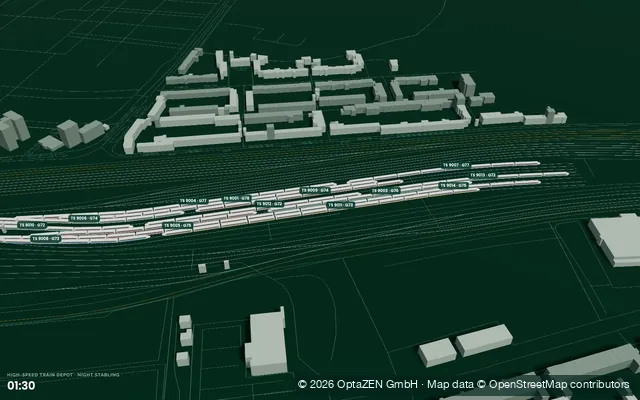
Which train goes to which maintenance track, in which order — and how does the shunting crew get them there?
Drag to rotate, scroll or pinch to zoom. The schedule below plays the plan; hover a bar for details. Plan computed with a Timefold model.
The planning question
High-speed train sets come in from service in the evening and must be back on the timetable in the morning. Maintenance orders (wash, inspections, drop-pit work, wheel re-profiling) come from the maintenance system. One shunting crew moves the trains through a switch ladder; three sidings buffer trains between jobs.
How we plan it
The Timefold model plans maintenance and shunting together — a free wheel lathe is useless if the train cannot be moved there in time.
What the plan shows
| KPI | Optimized plan | Comparison: arrival order |
|---|---|---|
| late trains | 1 | 1 |
| late minutes | 37 +35 | 2 |
| shunting conflicts (min) | 0 −30 | 30 |
| siding overflow (min) | 0 −77 | 77 |
Decisions
- maintenance track and start time per work order
- order of the work per train
- shunting moves through the switch ladder
Constraints
- track equipment (wash, pit, drop pit, wheel lathe)
- trains cannot turn between tracks: reverse via a head shunt
- one shunting crew, conflict-free moves
- siding capacity
- departure time in the morning
Objective
all trains back in service on time, no shunting conflicts, no siding overflow
Questions
Where do the work orders come from?
Typically from SAP PM or another maintenance system; completed orders are reported back.
What if a job takes longer?
The plan is updated and the following moves and jobs are re-planned.
More use cases
Your planning problem looks different?
Every operation has its own rules. Tell us about yours — we assess feasibility and expected impact in a free initial call.
Book a free call Write to us