
Night stabling in a high-speed train depot
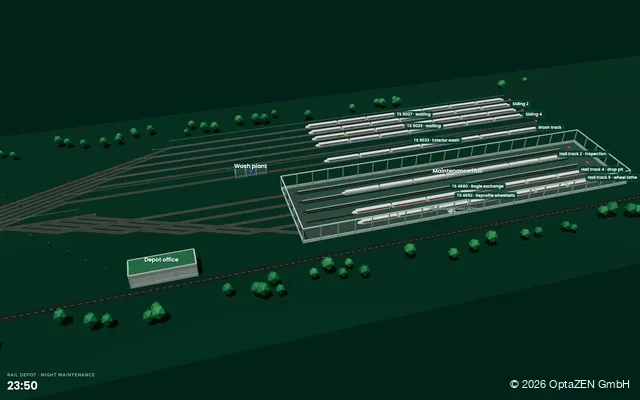
Which siding does each train set get tonight, so that nobody is blocked in the morning?
Drag to rotate, scroll or pinch to zoom. The schedule below plays the plan; hover a bar for details. Illustrative day plan from an optimizing heuristic; the Timefold model is built in a project.
The planning question
A high-speed train depot with a fan of stabling sidings. 15 train sets arrive in the evening and leave in the morning. Sidings are reached from one throat and are last-in, first-out, so a train parked behind a later departure blocks it. Every set also needs interior cleaning overnight.
How we plan it
Stabling is a sequencing problem: arrival and departure order must match the siding order. Planning sidings, cleaning and the throat together removes blocked departures.
What the plan shows
| KPI | Optimized plan | Comparison: first siding with room |
|---|---|---|
| trains blocked | 0 −2 | 2 |
| extra shunting moves | 0 −3 | 3 |
| late departures | 0 min −181 | 181 min |
| late trains | 0 −10 | 10 |
Decisions
- train set → siding and position
- cleaning team and time per set
- extra shunting moves where a train is blocked
Constraints
- one throat: last in, first out
- one movement at a time through the throat
- siding length (single or double sets)
- cleaning between arrival and departure, four teams
- one shunting crew
Objective
every train leaves on time without extra shunting, all sets cleaned
Questions
Is this a Timefold model?
The demo plan comes from an optimizing heuristic in the same format; in projects we build it with Timefold.
Can late arrivals be handled?
Yes. A delayed arrival re-plans the remaining sidings and cleaning slots.
More use cases
Your planning problem looks different?
Every operation has its own rules. Tell us about yours — we assess feasibility and expected impact in a free initial call.
Book a free call Write to us