
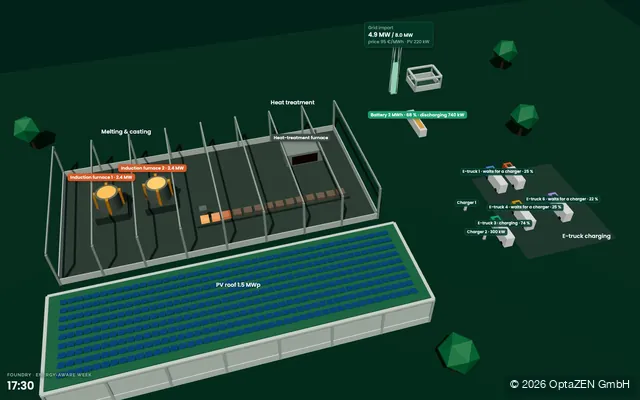
Charging electric trucks at a motorway hub
Which truck charges when, at which bay and with how much power — so long-haul drivers charge within their break, regional trucks get back on tour fast, and the hub stays within its grid connection?
Drag to rotate, scroll or pinch to zoom. The schedule below plays the plan; hover a bar for details. Plan computed with a Timefold model.
The planning question
A truck charging hub at the motorway: 4 megawatt chargers (MCS, 1 MW) and 8 CCS chargers (400 kW) in drive-through bays share a grid connection that is far smaller than all chargers at full power. Over a day, about 110 electric trucks arrive: long-haul trucks that take their mandatory 45-minute break here and need energy for the next 300–400 km, and regional distribution trucks that top up between tours. At peak times, first-come, first-served at full power overloads the connection and makes drivers queue.
How we plan it
The Timefold model treats charging sessions like jobs on machines with a grid balance per 5-minute slot: power is shifted between trucks so that each one finishes inside its break instead of all charging at full power at once.
What the plan shows
| KPI | Optimized plan | Comparison: first come, first served · load sharing |
|---|---|---|
| trucks charged | 110 / 110 | 110 / 110 |
| driver time lost per day | 912 € −164 | 1,076 € |
| average queue | 2.3 min −0.3 | 2.6 min |
| time beyond the break | 6.5 min −1.8 | 8.3 min |
| trucks queuing > 60 min | 0 | 0 |
| grid peak | 3,500 kW | 3,500 kW |
| MCS power while charging | 931 kW +36 | 895 kW |
Decisions
- bay (MCS or CCS), start and charging power per truck
- order of the queue at peak times
Constraints
- MCS bays only for MCS-capable trucks
- energy for the next leg delivered
- grid import within the connection in every 5-minute slot
- at most 60 minutes in the queue
- 45-minute driver break for long-haul, 20–30-minute stop for regional trucks
Objective
little driver time lost in the queue and beyond the break, low energy cost and peak
Questions
Why not always charge at full power?
Because the grid connection is limited. If every bay draws full power at noon, the hub overloads; spreading the power so each truck just finishes within its break serves more trucks without a bigger connection.
Does it work with bookings and live ETAs?
Yes. Booked slots and telematics ETAs update the plan; sessions that are running stay fixed.
More use cases
Your planning problem looks different?
Every operation has its own rules. Tell us about yours — we assess feasibility and expected impact in a free initial call.
Book a free call Write to us